What Types of Medical Documentation Can a Physician Complete?
Written by YiQiu Hu, NMD
Arizona-licensed naturopathic physician and concierge medicine provider
Published July 2026 | Medically reviewed July 2026
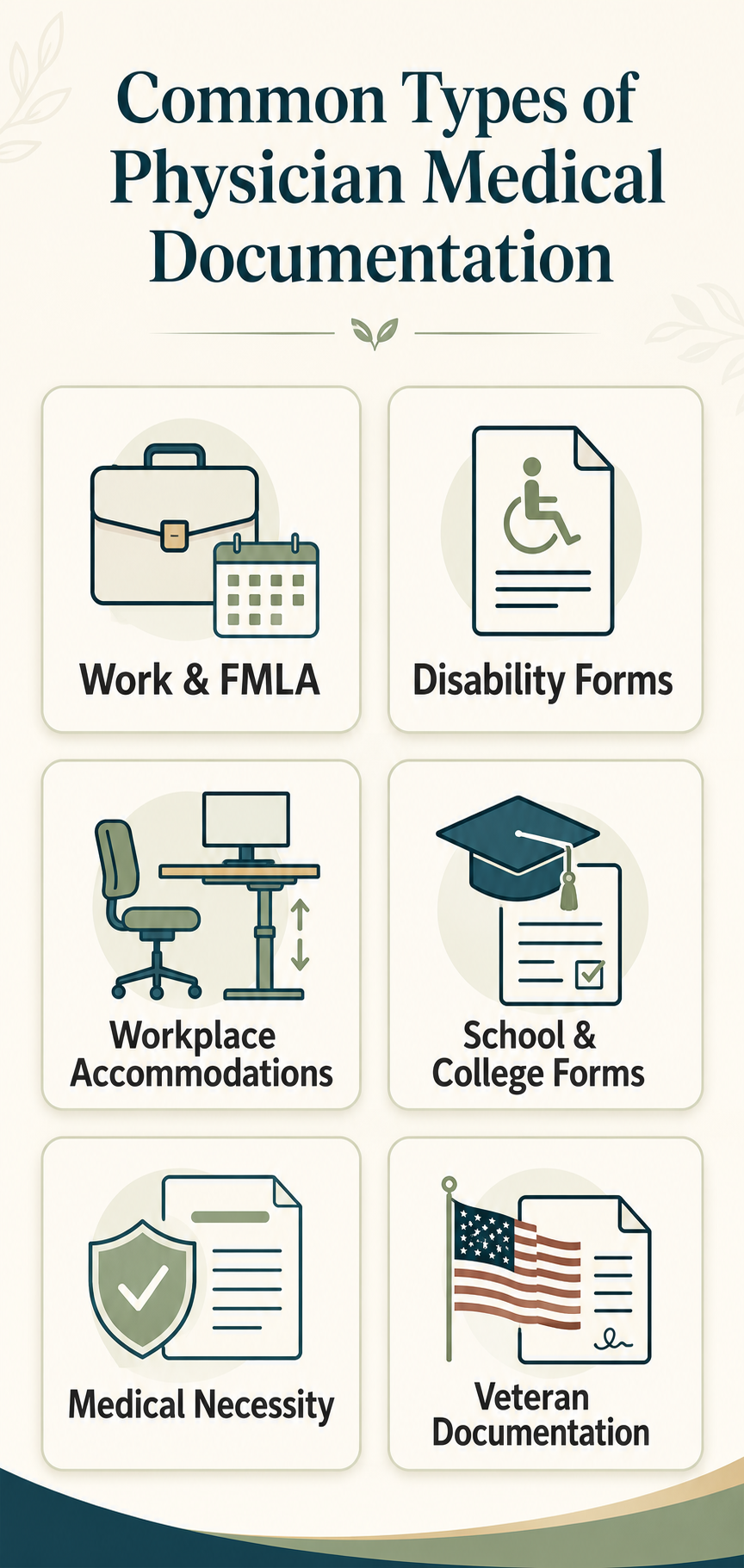
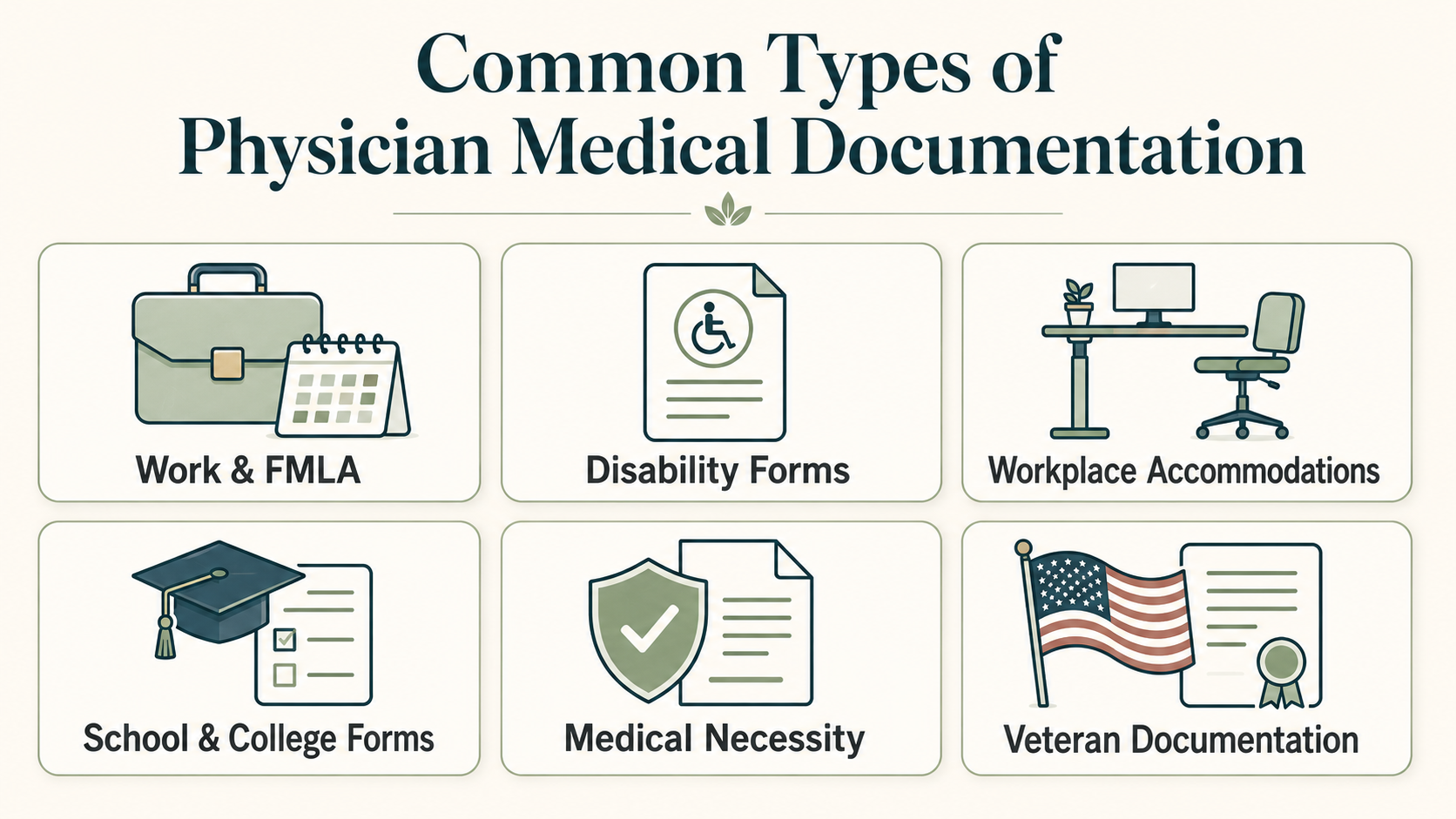
A physician can complete many types of medical documentation, including FMLA certifications, disability forms, workplace accommodation letters, return-to-work paperwork, school forms, letters of medical necessity, insurance appeals, physical examination forms, referral letters, and certain veteran-related documents.
However, a physician can only provide opinions that fall within the physician’s professional scope and are supported by the patient’s medical history, records, evaluation, and—when necessary—a physical examination. A physician’s signature does not automatically guarantee that an employer, insurer, school, government agency, or other organization will approve a request.


Common Types of Physician-Completed Medical Documentation
FMLA and medical-leave paperwork
Physicians frequently complete documentation supporting continuous or intermittent medical leave under the Family and Medical Leave Act.
Depending on the situation, the paperwork may document:
The general nature of a serious health condition
When the condition began
The expected duration of incapacity or treatment
Whether the patient is temporarily unable to work
The anticipated frequency and duration of intermittent absences
Whether follow-up appointments or recurring treatments are medically necessary
An employer may require medical certification for an employee’s own serious health condition or to care for a qualifying family member. The U.S. Department of Labor’s FMLA guidance explains that an employer may use its own certification form or one of the Department of Labor’s optional forms.
When leave is requested to care for a family member, the documentation ordinarily needs to be completed by the healthcare provider treating that family member.
Work notes, restrictions, and return-to-work documentation
A physician may provide a work note when a medical condition, injury, procedure, or treatment temporarily affects a patient’s ability to perform job duties.
This documentation may address:
Dates the patient should remain off work
When the patient may return
Temporary lifting, standing, walking, or activity restrictions
Reduced schedules or additional breaks
Restrictions involving driving, machinery, heat, or environmental exposure
Whether the patient may return without restrictions
When the patient should be reevaluated
The physician generally needs to understand the patient’s condition and the essential demands of the job. Employers ultimately decide whether a proposed restriction can be accommodated.
Short-term and long-term disability forms
Physicians may complete short-term or long-term disability paperwork describing how an illness or injury affects a patient’s functional abilities.
Disability documentation may include:
Relevant diagnoses and symptoms
Objective examination or testing findings
Treatment received
Medication effects
Physical or cognitive limitations
Ability to sit, stand, lift, walk, concentrate, or perform other activities
Expected duration of impairment
Follow-up and treatment plans
Prognosis when it can be reasonably estimated
The physician supplies medical information and a clinical opinion. The insurance company, benefits administrator, government agency, or other decision-maker determines whether the applicant satisfies its definition of disability.
Some disability forms are best completed by an established treating physician or the specialist primarily managing the condition. Learn more about Ask Dr. Hu’s physician medical documentation services.
Workplace accommodation letters
A physician may write a letter supporting a medically appropriate workplace accommodation. Examples can include:
A modified workstation
Permission to sit or stand as needed
Additional breaks
Modified lifting requirements
A temporary change in schedule
Remote work when medically appropriate
Reduced exposure to specific environmental triggers
Time away for appointments or treatment
Effective accommodation documentation focuses on the patient’s functional limitations and explains how the requested accommodation relates to those limitations.
According to the U.S. Equal Employment Opportunity Commission, an employer may request sufficient documentation supporting the existence of a covered limitation and the need for an accommodation, but generally should not request unrelated medical information or a patient’s entire medical record.
The physician can recommend an accommodation, but the employer makes the final decision through its accommodation process.
School, college, and educational documentation
Physicians can complete many forms requested by schools, colleges, universities, and testing organizations. These may include:
Absence or attendance documentation
School medication forms
Health-condition action plans
Academic accommodation letters
Testing accommodation documentation
Housing or dining accommodation requests
Physical activity restrictions
Return-to-school clearance
Sports participation forms
Some school or athletic forms require a recent physical examination, immunization information, laboratory testing, or evaluation by a particular specialist. A records review or virtual visit may not satisfy those requirements.
Letters of medical necessity
A letter of medical necessity explains why a particular treatment, medication, test, device, service, or accommodation is medically appropriate for an individual patient.
These letters may be used to support requests involving:
Prescription medications
Diagnostic testing
Medical equipment or supplies
Physical or rehabilitative therapy
Specialized treatment
Insurance coverage
Flexible spending or health savings account expenses
Travel modifications related to a medical condition
A strong letter usually describes the relevant condition, previous treatments, clinical rationale, anticipated benefit, and potential consequences of not receiving the requested service. The receiving organization still applies its own eligibility and coverage rules.
Insurance appeals and supporting medical letters
If an insurer denies a treatment, medication, test, or service, a physician may prepare an appeal or supporting clinical statement.
The appeal may include:
The patient’s medical history
Relevant examination and test findings
Treatments already attempted
Why alternatives may be inappropriate
Evidence supporting the requested service
The risks of delaying or denying treatment
A physician cannot promise that an appeal will be successful, but complete and well-supported documentation can help the insurer understand the medical reasoning behind the request.
Physical examination and health-clearance forms
Physicians may complete forms requiring documentation of a patient’s general health or ability to participate in a particular activity. Examples include:
Pre-employment physical forms
School or camp physicals
Sports participation forms
Procedure-related medical clearance
Fitness-for-duty evaluations
Adoption or foster-care health forms
General health-certification forms
These forms frequently require an in-person examination, vital signs, laboratory testing, vision or hearing screening, or additional specialist evaluation.
Certain examinations require a specially certified examiner. For example, interstate commercial-driver medical certificates must be issued by a clinician listed on the FMCSA National Registry of Certified Medical Examiners.
Specialist referrals and medical summaries
A physician may also prepare:
Specialist referral letters
Medical-history summaries
Treatment summaries
Medication and diagnosis summaries
Functional-limitation reports
Care-coordination letters
Requests for additional testing or consultation
These documents can help another healthcare professional understand the reason for the referral, relevant findings, treatments already attempted, and the specific question that needs to be addressed.
Ask Dr. Hu offers these services as part of a broader range of individual and concierge medical services in Arizona.
VA and veteran-related medical documentation
Depending on the physician’s qualifications, available evidence, and the nature of the condition, a physician may assist with veteran-related documentation such as:
VA Nexus letters
Independent Medical Opinion letters
Medical-record reviews
Symptom timeline documentation
Functional-limitation descriptions
Medical summaries supporting a disability claim
A physician preparing this type of documentation must conduct an independent review and provide an honest medical opinion based on the available evidence. The physician cannot guarantee a particular conclusion or determine whether the Department of Veterans Affairs will approve a claim.
Can a Physician Complete Any Form a Patient Requests?
No. A physician should not sign a form merely because a patient requests it.
The physician must have enough information to provide an accurate, defensible clinical opinion. A request may need to be declined or referred elsewhere when:
The form requires a particular specialist
The physician has not evaluated the relevant condition
The requested statement is not supported by the medical evidence
The organization requires its own approved examiner
A specialized physical examination or test is required
The request asks the physician to make a legal or administrative determination
The requested dates or limitations cannot be medically substantiated
The documentation falls outside the physician’s scope or expertise
When a specialist is required, the patient may need documentation from an orthopedic physician, psychiatrist, neurologist, cardiologist, ophthalmologist, occupational medicine clinician, certified medical examiner, or another appropriate professional.
Is an Appointment Required?
An appointment is often required, especially when the physician does not already have an established treatment history for the condition being documented.
During the evaluation, the physician may need to review:
Current symptoms
Medical and surgical history
Previous treatment
Medications and side effects
Medical records
Laboratory or imaging results
Job or school requirements
Functional limitations
The specific questions contained in the form
Many documentation requests can be evaluated through telemedicine when they primarily involve an interview and records review. An in-person visit may be necessary when the form requires a physical examination, vital signs, functional testing, or another hands-on assessment.
What Should I Provide to the Physician?
To reduce delays, provide the physician with:
Every page of the form, including instructions
The submission deadline
Relevant medical records
Recent laboratory or imaging results
A current medication list
The job description or essential duties, when applicable
Previous related documentation
Claim, employee, student, or case-identification information
Contact information for the receiving organization
Written authorization if the physician must communicate with a third party
Avoid completing sections designated specifically for the healthcare provider unless the form instructs you to do so.
How Long Does Medical Documentation Take?
Completion time depends on the complexity of the request, the number of pages, whether records must be obtained, and whether an appointment or physical examination is required.
Patients should submit requests as early as possible. Missing records, incomplete forms, unclear instructions, or requests requiring specialist input can extend the timeline.
The Bottom Line
Physicians can complete a broad range of employment, disability, educational, insurance, veteran, and healthcare documentation. However, every statement must be based on an appropriate evaluation and supported by the available medical evidence.
At Ask Dr. Hu, documentation requests are reviewed before completion to determine whether the requested form is medically appropriate, whether an appointment is needed, and whether another type of clinician or specialist is required.
If you need help with FMLA paperwork, disability forms, work documentation, school forms, a medical necessity letter, a VA Nexus letter, or another physician-completed document, explore our medical documentation services or contact Ask Dr. Hu to discuss your request.
When to Schedule a Medical Documentation Appointment
Consider scheduling a medical documentation appointment when an employer, school, insurer, government agency, or other organization asks for a physician-completed form or supporting medical letter. An appointment may also be appropriate if your documentation requires an updated assessment of your symptoms, treatment history, or functional limitations. Scheduling early allows time to review the form’s requirements, obtain relevant medical records, and determine whether a virtual consultation, in-person examination, or specialist evaluation is needed.