Concierge Medicine and Traditional Primary Care: What’s the Difference?
Written by YiQiu Hu, NMD
Arizona-licensed naturopathic physician and concierge medicine provider
Published August 2026 | Medically reviewed August 2026
Introduction
For many patients, choosing a primary care physician used to be relatively straightforward: find a doctor who accepts your insurance, schedule an appointment when needed, and return for routine checkups.
Today, patients have more options.
One increasingly discussed alternative is concierge medicine, a healthcare model designed to provide patients with greater physician access, longer appointments, more direct communication, and a more continuous relationship with their physician.
But how different is concierge medicine from traditional primary care?
Both models can provide high-quality medical care. Both can diagnose and treat illness, manage chronic medical conditions, order laboratory testing, prescribe medications, coordinate specialist referrals, and provide preventive healthcare.
The major differences are typically not what physicians are medically capable of doing, but rather how the practice is structured and how patients interact with their physician.
This article explains those differences so you can better determine which type of care may fit your healthcare needs, expectations, and budget.
If you are new to the concept, you may also want to begin with our complete guide to concierge medicine.


Concierge Medicine vs. Traditional Primary Care at a Glance
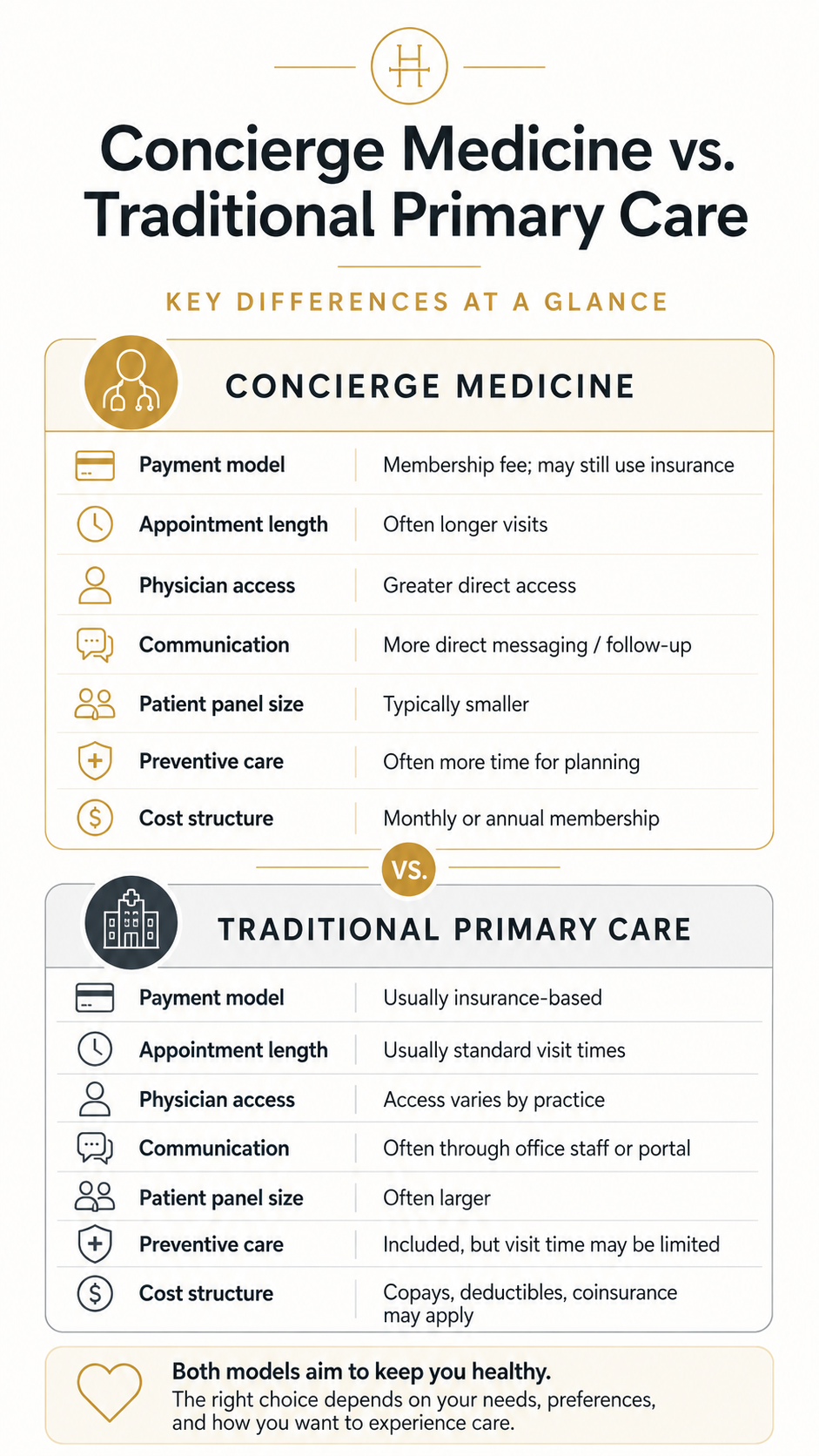
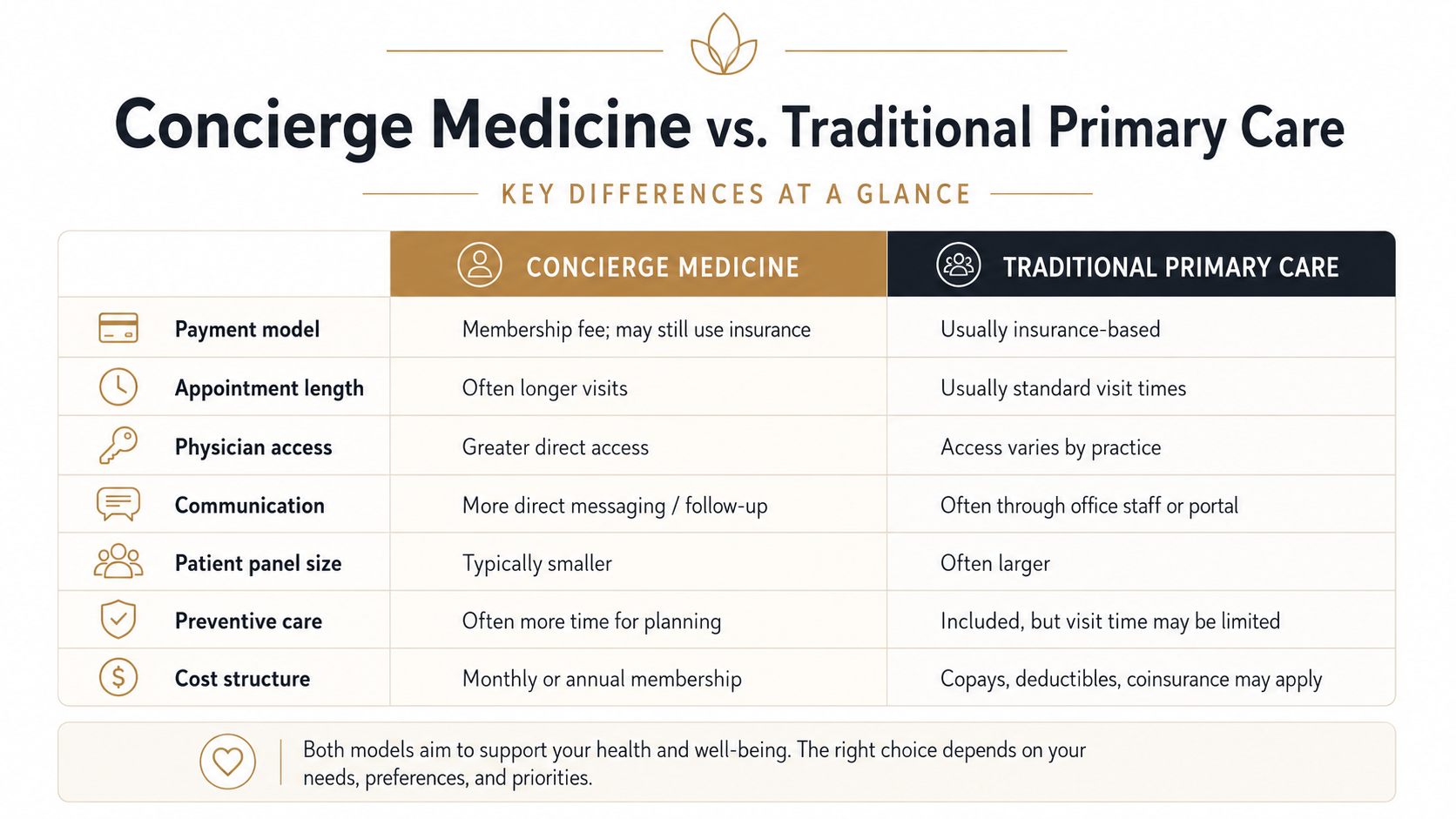
Concierge medicine and traditional primary care can provide many of the same core medical services. The biggest differences are generally how the practice is structured, how patients access their physician, how much time is available for visits, and how care is paid for.
Here are some of the most common differences:
Payment Model
Concierge medicine: Usually includes a monthly or annual membership fee. Depending on the practice, insurance may still be used for certain medical services.
Traditional primary care: Usually relies primarily on health insurance, with patients potentially responsible for copays, deductibles, or coinsurance.
Appointment Length
Concierge medicine: Appointments are often designed to allow more time for discussion, medical history review, laboratory interpretation, and treatment planning.
Traditional primary care: Appointment times are generally structured around the scheduling needs of a larger medical practice and may be shorter.
Physician Access
Concierge medicine: Patients may have greater access to their physician between scheduled appointments.
Traditional primary care: Access varies by practice and may occur primarily through scheduled appointments, office staff, or a patient portal.
Communication
Concierge medicine: Depending on the practice, patients may have access to direct messaging, telephone communication, email, virtual visits, or other forms of physician follow-up.
Traditional primary care: Communication is often coordinated through office staff, patient portals, telephone messages, or scheduled appointments.
Patient Panel Size
Concierge medicine: Physicians often intentionally maintain smaller patient panels so they can devote more time and availability to individual patients.
Traditional primary care: Physicians may care for substantially larger patient populations.
Preventive Care
Concierge medicine: The structure may provide additional time for preventive planning, health goals, laboratory trends, lifestyle counseling, and long-term risk reduction.
Traditional primary care: Preventive care remains an important part of primary care, although the amount of time available for these discussions may vary.
Cost Structure
Concierge medicine: Patients typically pay a recurring membership fee in addition to any healthcare expenses not included in the membership.
Traditional primary care: Patients typically pay according to their insurance benefits, including applicable deductibles, copays, and coinsurance.
The important distinction: Neither model is automatically better. Traditional primary care can provide excellent medical care, while concierge medicine may be particularly valuable for patients who place a greater emphasis on physician access, appointment time, continuity, and ongoing communication.
What Is Traditional Primary Care?
Traditional primary care is the healthcare model most Americans are familiar with.
Patients typically establish care with a family physician, internist, pediatrician, naturopathic physician where appropriately licensed, or another primary care professional and schedule appointments as health needs arise.
Depending on the practice, primary care may include:
Preventive examinations and health screenings
Evaluation of new symptoms
Diagnosis and treatment of common illnesses
Prescription medication management
Chronic disease management
Laboratory and imaging orders
Vaccinations when available
Specialist referrals
Follow-up after hospitalization or specialist care
Health and lifestyle counseling
Insurance frequently plays a central role in the traditional model. Physicians may bill a patient's health plan for covered services while the patient remains responsible for applicable deductibles, copayments, or coinsurance.
Traditional primary care remains an essential part of the healthcare system and can provide excellent medical care.
Its main challenges often arise from the operational realities of running a high-volume medical practice rather than from the capabilities of the physicians themselves.
What Is Concierge Medicine?
Concierge medicine generally uses a membership-based structure.
Patients pay a monthly or annual membership fee in exchange for access to a defined set of services or practice benefits.
Depending on the practice, these may include longer appointments, more convenient scheduling, direct physician communication, virtual visits, preventive health planning, laboratory review, chronic disease management, and care coordination.
A concierge practice can generally provide many of the same core medical functions as traditional primary care.
The difference is that the membership model may allow the physician to care for a smaller group of patients and devote more time and availability to each patient.
However, concierge medicine is not one standardized model.
One practice may primarily offer enhanced scheduling and communication. Another may provide extensive preventive planning, laboratory monitoring, telemedicine, home visits, or other services.
Patients should review the membership agreement carefully to understand exactly what is—and is not—included.
Difference #1: How Healthcare Is Paid For
One of the clearest differences is the payment structure.
Traditional Primary Care
Traditional practices commonly receive payment through health insurance.
The physician submits claims for covered medical services, and the patient may owe a deductible, copayment, coinsurance, or other cost depending on the health plan.
Concierge Medicine
Concierge practices generally charge a recurring membership or retainer fee.
The membership may pay for greater physician accessibility and specific services included in the practice agreement.
Depending on the concierge model, the physician may still bill insurance for certain covered services, operate partly on a self-pay basis, or use another payment arrangement.
This is also why patients should not assume that all membership-based practices work the same way.
Concierge medicine and direct primary care are sometimes discussed together, but they are not necessarily identical models. The American Academy of Family Physicians distinguishes direct primary care from many concierge arrangements based partly on how membership fees and insurance billing are structured.
For a deeper discussion of pricing, see How Much Does Concierge Medicine Cost?.
Difference #2: Appointment Length and Time With the Physician
Time is one of the most noticeable differences for many patients.
Traditional medical practices must balance appointment availability with the needs of a large patient population. As a result, visits may be organized around relatively standardized appointment blocks.
That structure works well for many straightforward medical concerns.
However, it can become more challenging when a patient has several concerns, a complicated health history, multiple medications, extensive laboratory results, or questions requiring a longer discussion.
Concierge practices are generally designed to give physicians more flexibility.
Longer appointments can provide additional time to:
Review multiple concerns
Discuss laboratory results
Review medications and supplements
Explore treatment alternatives
Discuss lifestyle and preventive strategies
Answer patient questions
Coordinate care with other healthcare professionals
More time does not automatically mean better medicine.
The potential advantage is that the physician may have more opportunity to understand the complete clinical picture rather than addressing only the most immediate concern.
Difference #3: Access to Your Physician
Another major distinction is what happens between appointments.
In many traditional practices, patients communicate through office staff, a patient portal, scheduled appointments, or telephone messages.
That structure is necessary when a physician is responsible for a large patient population.
Concierge practices may offer greater direct access.
Depending on the practice, patients may be able to communicate with their physician through secure messaging, telephone calls, email, text messaging, or virtual appointments.
This can be particularly useful when a patient needs to:
Ask whether a new symptom requires an appointment
Clarify medication instructions
Discuss an abnormal laboratory result
Provide an update after treatment
Determine whether urgent evaluation is appropriate
Ask a brief follow-up question
Communication policies vary substantially, however.
Patients should never assume that concierge membership means unlimited 24-hour physician availability.
A reputable practice should clearly explain expected response times, appropriate communication channels, after-hours policies, and situations requiring urgent or emergency medical care.


Difference #4: Patient-Panel Size and Continuity of Care
Concierge physicians often intentionally limit the number of patients enrolled in their practices.
A smaller patient panel can create more opportunities for continuity.
Instead of repeatedly introducing your history to different clinicians, you may work with the same physician over time.
Continuity can be particularly helpful when healthcare involves multiple moving pieces—for example:
Several chronic medical conditions
Multiple medications
Changing laboratory results
Specialist recommendations
Lifestyle interventions
Preventive screenings
Long-term treatment goals
The physician gradually becomes familiar not only with your diagnoses but also with your previous treatments, preferences, concerns, priorities, and response to therapy.
Traditional primary care can certainly provide this type of long-term relationship as well. Many patients have maintained excellent relationships with the same traditional family physician for decades.
The difference is that concierge practices are often deliberately structured around maintaining this degree of continuity and accessibility.
Difference #5: Preventive Care and Health Planning
Preventive medicine is part of both traditional and concierge primary care.
All good primary care should include appropriate attention to screenings, risk factors, vaccinations when indicated, lifestyle, cardiovascular health, metabolic health, and other preventive measures.
The potential difference is the amount of time and follow-up available for preventive planning.
Instead of simply checking whether basic screening recommendations are current, a longer visit may provide time to discuss questions such as:
What health risks are most important for this individual?
Which laboratory trends should be monitored?
What lifestyle factors could meaningfully improve long-term health?
Are weight, blood pressure, cholesterol, glucose, sleep, exercise, nutrition, or other modifiable factors changing over time?
What preventive tests are appropriate based on age, medical history, family history, medications, and individual risk?
Concierge medicine does not guarantee better prevention.
Rather, its structure may provide more opportunities to make preventive healthcare an ongoing process rather than an occasional conversation.
Patients interested in this aspect of care can also explore our Preventive Care and Health Optimization resources.


Difference #6: Managing Chronic or Complex Health Concerns
People with relatively simple healthcare needs may only need their primary care physician occasionally.
For patients managing several ongoing concerns, however, healthcare can become much more complicated.
There may be medications to monitor, laboratory testing to repeat, specialists to coordinate with, lifestyle recommendations to implement, and symptoms that change between scheduled appointments.
Traditional primary care physicians routinely manage chronic disease and complex medical conditions.
Concierge medicine does not change the fundamental medical principles involved.
What may change is the physician's ability to provide more frequent communication, longer follow-up, and greater continuity.
That may be useful for patients who value having one physician maintain a broader view of their care while specialists address particular areas of expertise.
A concierge physician should also recognize the limits of primary care and refer to appropriate specialists when a condition requires expertise or treatment outside the physician's scope.
Difference #7: Health Insurance Is Still Important
A common misunderstanding is that paying for concierge medicine eliminates the need for health insurance.
It generally does not.
Concierge membership and health insurance serve different purposes.
A membership may provide enhanced access to your physician and services specified in your agreement.
Insurance may still be important for major medical expenses and services obtained outside the concierge practice, such as:
Emergency department care
Hospitalization
Surgery
Specialist treatment
Advanced imaging
Prescription medications
Laboratory testing not included in a membership
Medical procedures
Other covered healthcare services
For Medicare beneficiaries specifically, Medicare states that concierge membership fees themselves are not covered by Medicare. Individual physicians and practices must also follow applicable Medicare rules regarding covered services and membership arrangements.
Patients should therefore understand both their concierge membership agreement and their insurance coverage before enrolling.
Difference #8: Convenience Does Not Eliminate Medical Boundaries
Greater access is valuable, but it is important to understand what concierge medicine cannot replace.
Concierge care is not an emergency department.
It is not a substitute for hospitalization.
It does not eliminate the need for specialists.
And not every medical concern can be safely evaluated through telemedicine, text messaging, or telephone communication.
For example, certain symptoms may require an in-person physical examination, imaging study, laboratory testing, urgent care evaluation, emergency department evaluation, or specialist consultation.
A responsible concierge physician should help patients navigate the healthcare system—not attempt to replace every part of it.
This distinction is important because the value of concierge medicine comes partly from having a physician who can help determine what level of care is appropriate and when additional evaluation is necessary.
Is Concierge Medicine Better Than Traditional Primary Care?
Not necessarily.
The better question is:
Which healthcare model better matches your needs?
An excellent traditional primary care physician may be a better choice than a poorly matched concierge physician.
Likewise, a concierge practice may provide meaningful value for a patient who has difficulty obtaining the amount of access, communication, or continuity desired through a conventional practice.
The quality of medical care ultimately depends on much more than the payment model.
Important factors include:
The physician's education and licensure
Clinical judgment
Communication skills
Evidence-informed decision-making
Knowledge of professional limitations
Appropriate referrals
Follow-up
Patient safety
Whether the physician-patient relationship is a good fit
The concierge model primarily changes the structure surrounding that relationship.
Who May Prefer Concierge Medicine?
Concierge care may be worth considering for patients who place a high value on physician accessibility and continuity.
Examples may include people who prefer longer appointments, want easier communication between visits, have multiple health concerns, manage chronic medical conditions, travel frequently, want ongoing preventive planning, or simply prefer having a physician who has more time to become familiar with their healthcare history.
Some patients also choose concierge medicine because their time has value.
For a busy professional, parent, caregiver, or business owner, the ability to obtain medical guidance without repeatedly navigating scheduling barriers may itself be meaningful.
The decision is ultimately personal.
Membership should provide benefits that you actually expect to use.
Who May Prefer Traditional Primary Care?
Traditional primary care remains entirely appropriate for many patients.
It may be a better fit if you are satisfied with your current physician, have relatively infrequent healthcare needs, do not require significant communication between appointments, prefer to minimize additional out-of-pocket expenses, or have access to a traditional practice that already provides the time and continuity you need.
There is no medical requirement to join a concierge practice simply because the option exists.
The value depends on how much you personally benefit from the additional access and services provided.
What Should You Compare Before Joining a Concierge Practice?
Do not choose a practice based on the word “concierge” alone.
Before enrolling, understand exactly how that particular practice works.
Ask about the physician's qualifications, membership price, services included, appointment availability, expected appointment length, communication methods, response times, after-hours policies, laboratory costs, prescription management, specialist referrals, telemedicine availability, in-person care, cancellation policies, and services that require additional payment.
You should also understand what happens when your physician is unavailable and what situations require urgent or emergency care.
Our Patient's Guide to Joining a Concierge Medicine Practice provides a more detailed checklist for evaluating a practice before enrolling.
Concierge Medicine at Ask Dr. Hu
At Ask Dr. Hu, our approach to concierge medicine is built around a simple idea: physicians provide better guidance when they have enough time to understand the patient in front of them.
Our concierge membership is designed for Arizona patients seeking an ongoing physician relationship with greater access, continuity, preventive planning, and personalized medical guidance.
Current membership features include direct physician communication, virtual care, ongoing medical management, preventive healthcare, chronic condition support, laboratory review, and care coordination.
Because every patient has different needs, concierge membership is not required to use every service offered through our practice.
You can review our current services and membership structure on the Ask Dr. Hu Membership page or explore our medical services.
The Bottom Line
Concierge medicine and traditional primary care share the same fundamental purpose: helping patients receive appropriate medical care and maintain their health.
The major difference is how that care is delivered.
Traditional primary care usually operates within an insurance-centered healthcare model designed to serve a relatively large patient population.
Concierge medicine generally uses a membership structure that allows practices to offer greater physician access, longer appointments, more direct communication, and stronger continuity.
Neither model is automatically better.
For some patients, traditional primary care provides everything they need.
For others, having additional time and access to a physician may substantially improve their healthcare experience.
Before deciding, consider not only the membership fee but also how you prefer to communicate with your physician, how frequently you need care, how complex your health needs are, and how much you value continuity and accessibility.


Considering Concierge Medicine in Arizona?
If you are looking for a more personalized approach to ongoing medical care, Ask Dr. Hu provides concierge medicine for patients throughout Arizona.
Our goal is to provide thoughtful healthcare built around accessibility, continuity, preventive medicine, and enough time to understand the complete picture of your health.
You can review our concierge membership or contact Ask Dr. Hu if you have questions about whether the practice may be a good fit for your healthcare needs.
Medical Review & Editorial Standards
This article was written for patient education by an Arizona-licensed naturopathic physician with clinical experience in concierge medicine, preventive healthcare, chronic disease management, and individualized medical care.
The article is intended to provide a balanced comparison of healthcare delivery models rather than suggest that one model is appropriate for every patient.
Information regarding membership-based care and related primary care models was reviewed alongside guidance and educational material from organizations including the American Academy of Family Physicians and Medicare.
Medical services, membership structures, insurance arrangements, and physician availability vary between practices. Patients should review the policies of the individual physician or practice they are considering.
Last medically reviewed: August 2026
About the Author
YiQiu Hu, NMD
Dr. YiQiu Hu is an Arizona-licensed naturopathic physician and the founder of Ask Dr. Hu. His clinical work focuses on concierge medicine, preventive healthcare, health optimization, laboratory evaluation, chronic disease management, medical weight management, hormone care, and individualized treatment planning.
Dr. Hu created Ask Dr. Hu to provide patients with a more accessible and relationship-centered healthcare experience built around longer conversations, direct communication, continuity of care, and practical medical guidance.
He earned his Doctor of Naturopathic Medicine degree from Sonoran University of Health Sciences and a Bachelor of Science in Biomedical Sciences from Northern Arizona University. In addition to patient care, Dr. Hu has extensive experience in medical leadership and multidisciplinary healthcare practice management.
Learn more about Dr. YiQiu Hu and the physicians at Ask Dr. Hu.
This article is intended for general educational purposes only and does not replace individualized medical advice, diagnosis, or treatment. Reading this article does not establish a physician-patient relationship. If you are experiencing a medical emergency, call 911 or seek appropriate emergency medical care.