Medical Documentation: A Complete Guide for Patients
Written by YiQiu Hu, NMD
Arizona-licensed naturopathic physician and concierge medicine provider
Published July 2026 | Medically reviewed July 2026
Medical documentation can play an important role when a health condition affects your ability to work, attend school, participate in certain activities, obtain insurance coverage, or access disability-related benefits.
Depending on your situation, you may need a physician to complete a form, explain your medical limitations, provide a professional medical opinion, or confirm that a particular treatment or accommodation is medically appropriate.
Although these requests are sometimes described as “just paperwork,” responsible medical documentation requires much more than a physician’s signature. The information must be accurate, supported by an appropriate evaluation, consistent with the available medical evidence, and tailored to the requirements of the organization receiving it.
This guide explains the most common types of medical documentation, what physicians evaluate before completing a request, what patients should bring to an appointment, and why some documentation may require additional testing, records, or specialist involvement.
Patients seeking individualized assistance can learn more about our medical documentation services in Arizona.


What Is Medical Documentation?
Medical documentation is written information prepared or certified by a healthcare professional to communicate clinically relevant facts about a patient’s health.
Depending on the request, documentation may address:
A diagnosed or suspected medical condition
The history and expected duration of the condition
Current symptoms and clinical findings
Treatment history
Physical or cognitive limitations
The effect of the condition on work, school, or daily activities
Recommended restrictions or accommodations
Whether a patient is medically able to participate in an activity
Why a treatment, medication, device, or service is medically necessary
The medical basis for a professional opinion
Medical documentation may take the form of a short letter, a standardized form, a narrative medical report, a medical-record summary, or a more extensive independent medical opinion.
The amount of evaluation required depends on the complexity and purpose of the request.
Medical Documentation Is More Than a Doctor’s Note
A simple work or school note may confirm that a patient was evaluated on a particular date. More complex requests may require a detailed analysis of medical records, diagnostic testing, functional limitations, job duties, prior treatments, and expected recovery.
The physician signing the document assumes professional responsibility for the accuracy of the information provided.
For that reason, physicians should not certify a diagnosis, limitation, period of disability, or medical opinion that cannot be reasonably supported. A physician also cannot guarantee that an employer, school, insurer, government agency, or other organization will accept a form or approve the patient’s request.
The physician’s role is to provide an objective medical assessment. The receiving organization makes the final administrative, employment, insurance, or legal decision.
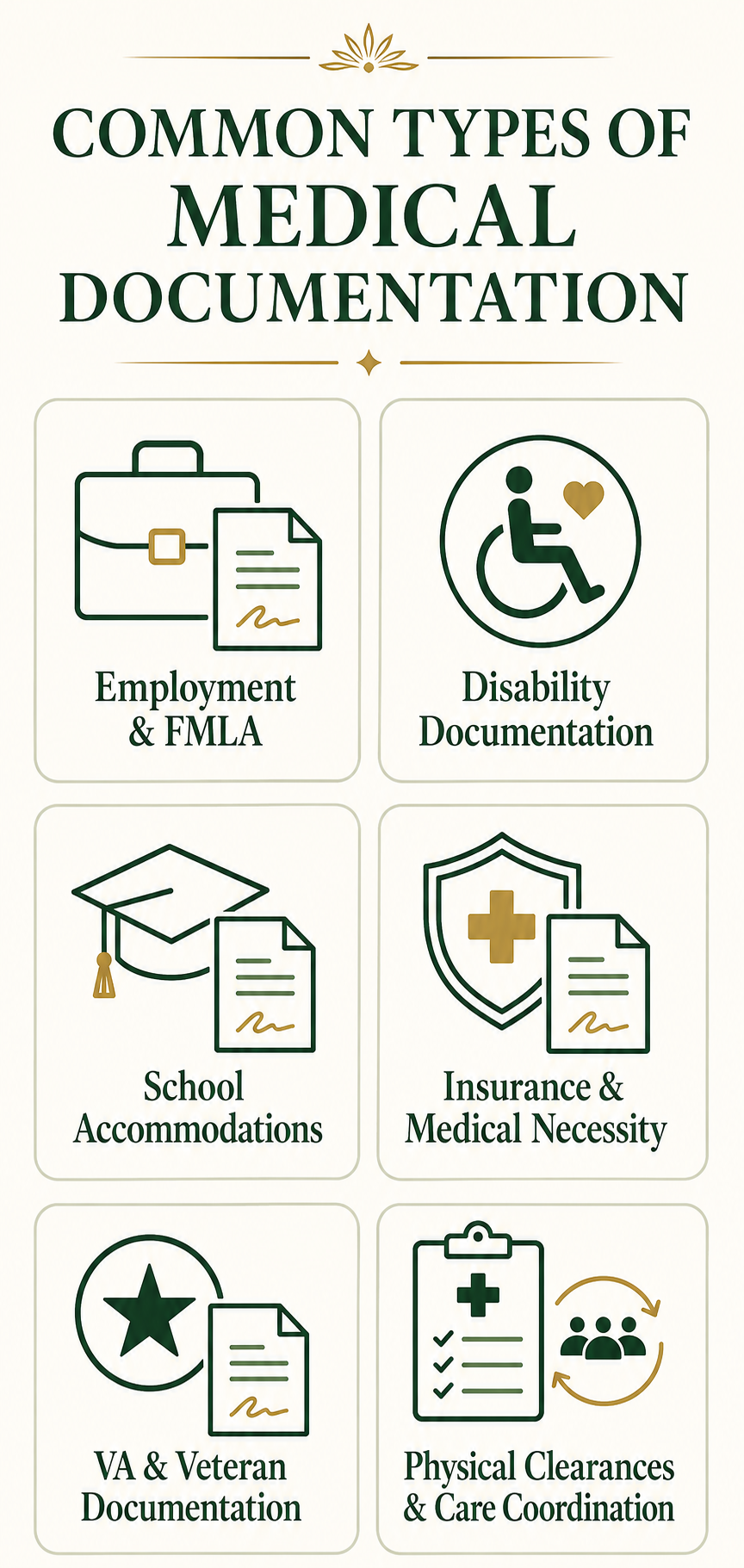
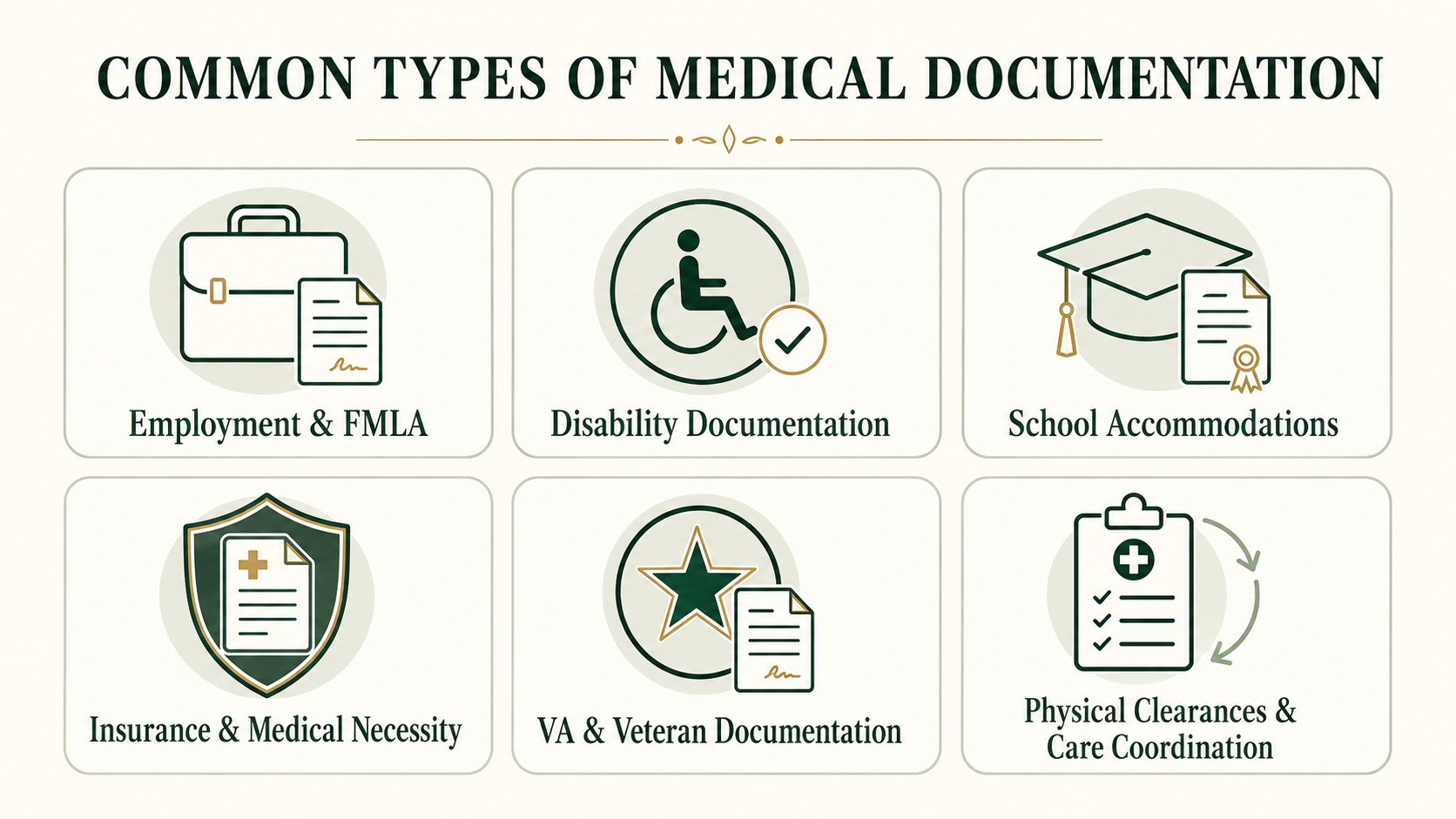
Common Types of Medical Documentation
Employment and Workplace Documentation
Health conditions can affect a person’s ability to perform certain job duties safely and consistently. Employment-related documentation helps explain those effects to an employer, human-resources department, leave administrator, or disability carrier.
Examples include:
Work notes
Return-to-work letters
Work restriction or modified-duty recommendations
Fitness-for-duty evaluations
Medical leave documentation
Family and Medical Leave Act paperwork
Intermittent FMLA certification
Short-term disability forms
Long-term disability forms
Workplace accommodation letters
Workers’ compensation documentation when appropriate
Whenever possible, patients should provide a written job description or list of essential job functions. A lifting restriction, for example, has a very different practical effect for someone working at a desk than for someone whose position requires frequent lifting.
FMLA Medical Certification
The Family and Medical Leave Act may provide eligible employees with job-protected, unpaid leave for certain qualifying medical and family circumstances.
An employer may request medical certification describing the serious health condition, its expected duration, the need for leave, and whether leave is expected to be continuous, intermittent, or taken through a reduced schedule.
According to the U.S. Department of Labor’s FMLA guidance, employees are generally responsible for providing complete and sufficient certification within the timeframe established by their employer—usually at least 15 calendar days after the request.
Patients should bring:
The complete form provided by the employer
The stated submission deadline
Their job description or essential duties
The requested leave dates
Relevant medical records
Information about anticipated appointments or treatment
Contact information for the leave administrator
Patients should also verify that their employer or leave administrator will accept certification from the type of healthcare professional completing the form. Requirements can differ depending on the form, employer, plan, and applicable rules.
Workplace Accommodation Letters
Some employees need temporary or ongoing changes that help them perform their essential job duties while managing a medical condition.
Potential accommodations may include:
Modified work schedules
Additional or periodic breaks
Temporary lifting restrictions
Reduced standing or walking
Ergonomic equipment
Time for medical appointments
Temporary remote work when appropriate
Changes to specific environmental exposures
Modified duties during recovery
The physician’s documentation typically focuses on the relevant medical limitations and how an accommodation may address them. It does not necessarily require disclosure of the patient’s complete medical history.
The U.S. Equal Employment Opportunity Commission explains that when documentation is appropriate, an employer generally may request information needed to establish the disability and related functional limitations—not unrelated medical records.
The employer ultimately determines whether a requested accommodation can be provided through its interactive process.
Short-Term and Long-Term Disability Documentation
Disability forms generally require more detail than a routine work note.
The physician may be asked to document:
The medical condition
The date symptoms or disability began
Objective examination findings
Diagnostic testing
Treatment history
Medications and potential side effects
Functional limitations
Expected recovery or reassessment dates
The patient’s ability to perform specific occupational duties
Having a diagnosis does not automatically establish disability. The documentation must usually explain how the condition limits the patient’s ability to perform relevant activities or job functions.
Disability carriers and benefit programs use their own definitions and eligibility standards. A physician provides medical evidence, but the carrier or agency decides whether the patient meets the applicable requirements.
Return-to-Work and Fitness-for-Duty Documentation
Before returning after an illness, injury, hospitalization, or surgery, an employer may ask whether the employee can safely resume work.
A return-to-work evaluation may consider:
Current symptoms
Physical examination findings
Medication effects
Mobility, strength, balance, or endurance
Cognitive demands
Risk of reinjury
The essential functions of the position
Whether restrictions or accommodations are needed
Physicians may recommend unrestricted work, temporary restrictions, modified duties, a gradual return, or additional recovery time.
Safety-sensitive positions may require specialized testing or evaluation by an occupational medicine provider, surgeon, specialist, or another designated examiner.
School and Educational Documentation
Students may need documentation when an illness, injury, or disability affects attendance, academic performance, testing, housing, transportation, or participation in school activities.
Examples include:
School absence notes
College accommodation letters
Testing accommodation documentation
Modified physical-education recommendations
Medical withdrawal forms
Housing or dining accommodation requests
Return-to-school clearances
Documentation for chronic health conditions
Schools and testing organizations may have specific documentation standards. Patients should obtain those requirements before their appointment so the physician can determine what information and evaluation are necessary.
Medical Necessity and Insurance Letters
Insurance companies sometimes request additional clinical information before approving a medication, treatment, procedure, medical device, or other healthcare service.
A letter of medical necessity may include:
The patient’s diagnosis
Relevant symptoms and clinical findings
Treatments previously attempted
Why alternatives were ineffective, inappropriate, or contraindicated
The requested treatment or service
The anticipated medical benefit
Supporting laboratory, imaging, or specialist findings
A well-supported letter may help the insurer understand the clinical reasoning, but it cannot guarantee authorization or payment.
VA Disability and Veteran Medical Documentation
Veterans may need medical evidence when pursuing a VA disability claim or requesting review of an existing rating.
Documentation may include:
Medical-record reviews
Symptom timelines
Functional limitation assessments
Independent medical opinions
VA nexus letters when medically supported
Documentation addressing the severity of a current condition
The physician may need to evaluate the veteran’s current diagnosis, service and treatment records, symptom history, relevant exposures or events, and current medical evidence.
The Department of Veterans Affairs explains that evidence may include medical records and professional medical opinions, depending on the type of claim. More information is available through the VA’s official guide to evidence needed for a disability claim.
A physician’s report should remain independent and evidence-based. Neither a nexus letter nor any other medical opinion guarantees that the VA will approve a claim or assign a particular disability rating.
Physical Examinations and Medical Clearances
Some organizations require medical clearance before a person begins or resumes an activity.
Examples include:
Employment physicals
School or sports participation
Camps
Volunteer programs
Adoption requirements
Travel or activity clearances
Certain occupational or safety-sensitive duties
These requests frequently require an in-person physical examination. Laboratory testing, imaging, immunization records, vision testing, cardiac evaluation, specialist clearance, or other assessments may also be necessary.
Physician-to-Physician and Care Coordination Documentation
Medical documentation is also used to communicate important information between healthcare professionals.
This may include:
Specialist referral letters
Consultation summaries
Medical-record summaries
Treatment updates
Care coordination letters
Transfer-of-care documentation
Explanation of previous evaluations or treatments
Patients seeking ongoing medical management and care coordination may also want to review our concierge medicine membership.
What Makes Medical Documentation Clinically Strong?
High-quality documentation is not necessarily the longest report. It is the report that answers the relevant questions clearly and supports its conclusions with appropriate medical evidence.
Strong documentation generally includes:
A clear explanation of the document’s purpose
Relevant diagnoses and medical history
Current symptoms and clinical findings
Objective testing when available
Previous and current treatment
Specific functional limitations
The anticipated duration of those limitations
Appropriate recommendations
The physician’s professional reasoning
The date, signature, credentials, and contact information of the clinician
Whenever possible, recommendations should be specific. “The patient cannot work” may be less useful than a description of which essential duties the patient cannot currently perform, why those duties are limited, and when reassessment is appropriate.
What Does the Physician Evaluate?
Before completing documentation, the physician may consider:
Whether a physician-patient relationship has been established
Whether the condition falls within the physician’s scope of practice
Whether the diagnosis is sufficiently supported
Whether the available records are complete
Whether an examination is required
Whether the requested opinion can be reached reliably
Whether the stated restrictions match the clinical findings
Whether a specialist is better qualified to complete the request
Whether the receiving organization requires a particular credential or form
Whether the documentation could affect patient or public safety
Some requests can be completed during an initial evaluation. Others require additional records, testing, specialist consultation, or follow-up over time.
What Should You Bring to a Documentation Appointment?
Preparing in advance can reduce delays and prevent the need for unnecessary revisions.
Bring or securely submit:
The complete form or written documentation request
All instructions from the receiving organization
The submission deadline
Your job description or essential work duties
Relevant medical records
Laboratory and imaging reports
Specialist notes
Hospital or surgical records
A current medication list
Dates of symptoms, treatment, and missed work or school
Previous related forms or determinations
Contact information for the intended recipient
Any authorization required to release information
Complete every section designated for the patient before giving the form to the physician. Do not complete or alter sections designated for the healthcare professional.
What Should You Expect During the Process?
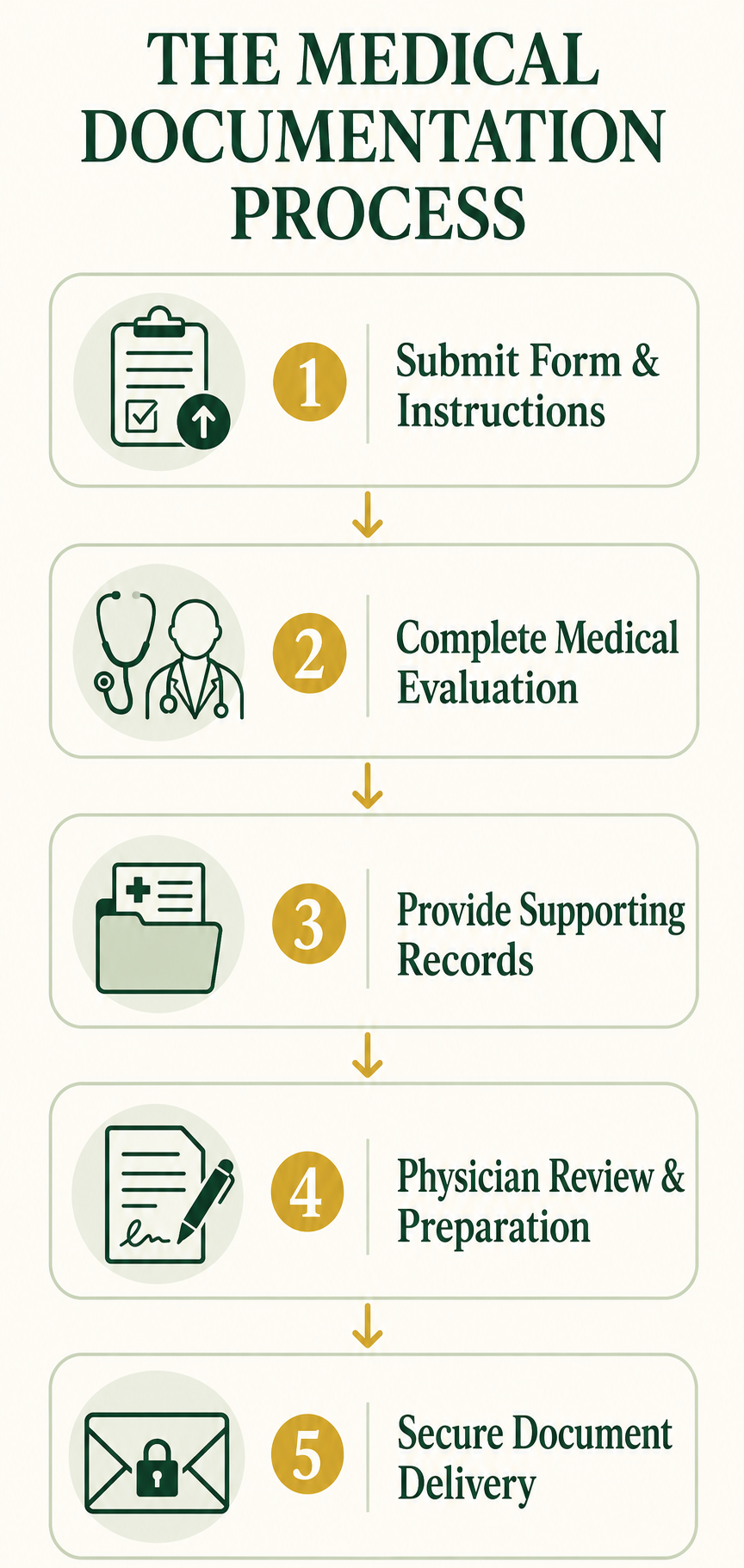
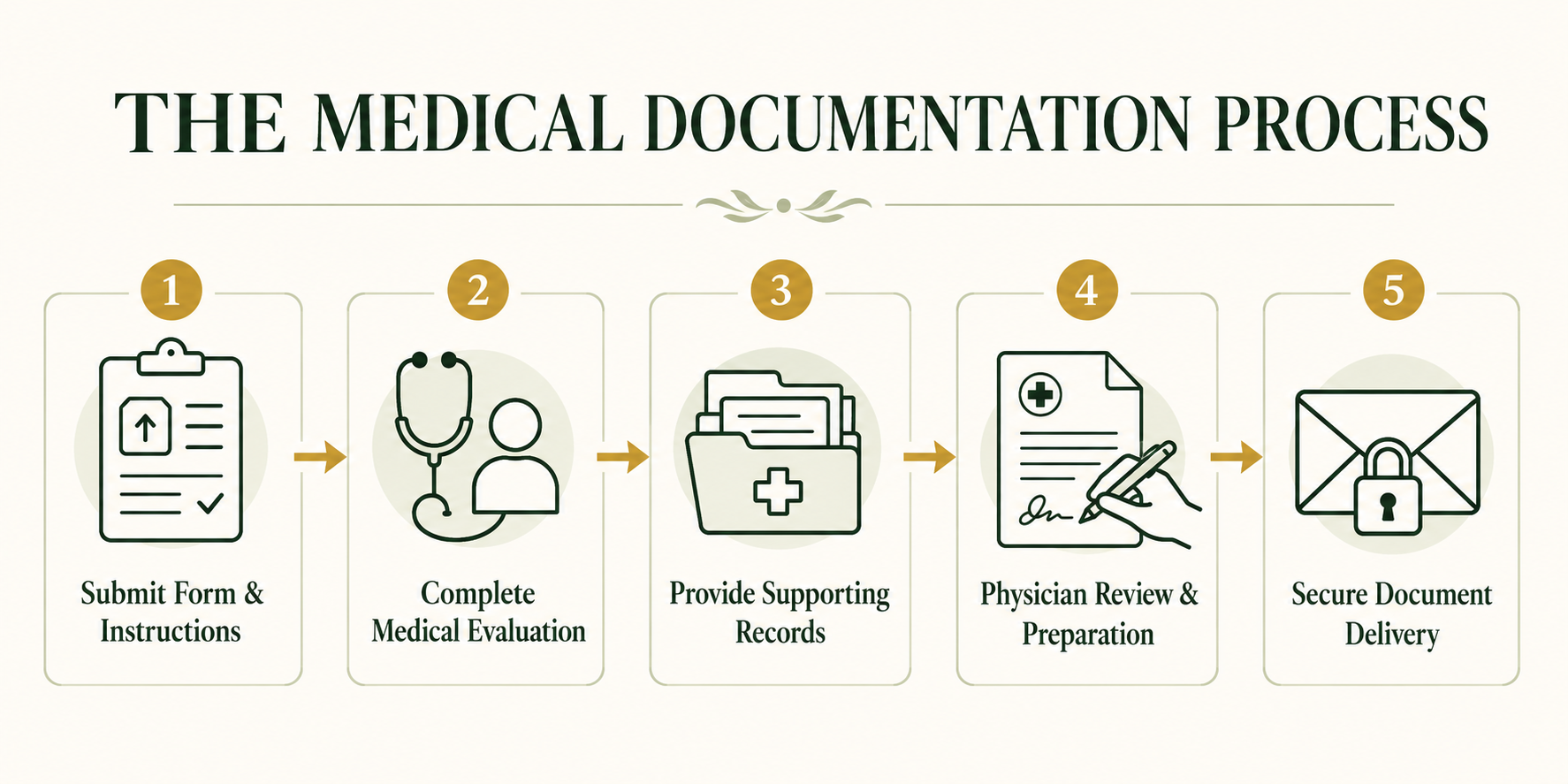
The medical-documentation process commonly includes the following steps:
Initial review: The physician reviews the form, instructions, deadline, and purpose of the request.
Medical evaluation: The patient’s symptoms, history, treatments, and functional limitations are assessed.
Record collection: Relevant medical records, diagnostic results, and specialist reports are reviewed.
Additional evaluation when necessary: An in-person examination, laboratory testing, imaging, or specialist assessment may be recommended.
Document preparation: The physician completes the form or writes a report based on the available evidence.
Patient review and authorization: The patient may need to confirm identifying or administrative information and authorize release.
Secure delivery: The completed document is provided to the patient or sent to the designated recipient through an appropriate method.
Documentation should not be submitted through an unsecured general-contact form. If protected health information is needed, the practice should provide instructions for secure transmission.
Can Medical Documentation Be Completed Through Telemedicine?
Some documentation can be completed through telemedicine, particularly when the request is based mainly on a detailed history and existing medical records.
Telemedicine may be appropriate for:
Certain medical-record reviews
Some work or school notes
Follow-up documentation
Selected accommodation requests
Some FMLA or disability evaluations
Certain medical-necessity letters
An in-person evaluation may be necessary when documentation requires:
A physical examination
Measurement of strength, mobility, balance, or neurological function
A sports or occupational physical
Cardiovascular or pulmonary assessment
Verification of physical limitations
Safety-sensitive clearance
Specialized testing
The physician determines the appropriate visit format after reviewing the request.
Why Might a Physician Decline or Limit a Request?
A physician may be unable to complete documentation when:
There is insufficient medical evidence
The requested statement conflicts with the clinical findings
The physician has not evaluated the relevant condition
The request asks the physician to certify past events that cannot be verified
The form requires a specialist or designated examiner
An in-person examination is necessary but has not occurred
The requested restriction is not medically supported
The physician cannot reach the requested opinion with reasonable clinical confidence
The request falls outside the physician’s scope of practice
When a request cannot be supported exactly as written, the physician may be able to provide a more limited statement based on the information that can be verified.
Privacy and Release of Medical Information
Medical documentation often contains protected health information. Patients may need to sign a written authorization before information can be sent directly to an employer, school, insurer, attorney, or other third party.
The U.S. Department of Health and Human Services notes that healthcare providers generally cannot release medical information directly to an employer without the patient’s authorization unless another law permits or requires the disclosure.
Documentation should include the information reasonably necessary for its intended purpose without unnecessarily revealing unrelated medical details.
How Long Does Medical Documentation Take?
Completion time depends on:
The length and complexity of the form
The number of medical records requiring review
Whether an appointment is necessary
Whether testing or specialist input is required
Whether important information is missing
Whether the document requires a detailed medical opinion
Whether revisions or clarification are requested
Patients should submit requests as early as possible. A physician cannot guarantee that a complex form or report can be completed immediately, particularly when extensive record review is required.
How Much Does Medical Documentation Cost?
Medical-documentation services at Ask Dr. Hu currently begin at $150, with the final cost depending on the complexity of the request, evaluation required, length of the form, and amount of medical-record review.
Medical-documentation fees may not be covered by health insurance, particularly when the work is considered an administrative service rather than covered medical treatment. Patients should request pricing information before beginning the evaluation.
You can review our other individual medical services for additional information.
-
Usually, yes. The physician must have enough current medical information to support the statements being certified. A new or complex request will generally require an appointment, while certain follow-up forms may be completed from recent records.
-
No. The physician provides an objective medical assessment. The employer, school, insurance company, disability carrier, VA, or government agency makes the final decision.
-
A physician may document the history you report, but may not be able to independently verify that you were medically unable to work or attend school on a past date when no evaluation occurred.
-
Sometimes. Telemedicine may be sufficient when the request can be supported by medical history and existing records. Physical clearances and requests involving measurable physical limitations may require an in-person examination.
-
Updated documentation may be necessary. Restrictions, leave schedules, return-to-work dates, and accommodation needs should be reassessed when the medical circumstances change significantly.
-
You may be referred to the appropriate specialist, surgeon, occupational medicine provider, mental health professional, or designated examiner. A primary care physician can sometimes provide supporting records or a referral summary.
-
Coverage varies. Many insurers do not cover administrative paperwork, extensive record review, disability forms, or independent medical opinions. Contact your insurance plan and the physician’s office before assuming that the service is covered.
Frequently Asked Questions
The Bottom Line
Medical documentation connects clinical information with practical decisions involving employment, education, disability, insurance, military benefits, and participation in certain activities.
The strongest documentation is accurate, specific, clinically supported, and focused on the questions being asked. Patients can help by providing the complete form, instructions, deadlines, job or school requirements, and all relevant medical records before their appointment.
A physician can explain a medical condition and its functional effects, but cannot guarantee that a third party will approve a request or provide a particular benefit.
Ask Dr. Hu provides individualized medical evaluations and physician documentation for employment, disability, military, educational, insurance, and healthcare-related needs.
Each request is reviewed individually to determine whether it can be completed responsibly, whether an appointment is required, and whether additional records, testing, or specialist evaluation may be needed.
Need Help With Medical Documentation in Arizona?
This article is intended for general educational purposes and does not constitute medical, legal, employment, disability, or insurance advice. Requirements and eligibility decisions are determined by the applicable employer, school, insurer, benefit plan, or government agency.