Do I Need Imaging Before Starting Treatment?
Written by YiQiu Hu, NMD
Arizona-licensed naturopathic physician and virtual concierge medicine provider
Published August 2026 | Medically reviewed August 2026

Quick answer: Not always. Many patients can begin conservative treatment for musculoskeletal pain without first having an X-ray, MRI, CT scan, or other advanced imaging. Whether imaging is necessary depends on your symptoms, medical history, physical examination, suspected diagnosis, previous treatments, and the type of treatment being considered.
In some situations, imaging can provide valuable information or may be necessary before proceeding with a particular treatment. In others, ordering imaging immediately may not change the treatment plan.
At Ask Dr. Hu, our approach to integrative pain management begins with a careful clinical evaluation. Imaging is recommended when it is likely to provide information that meaningfully affects diagnosis, treatment selection, or patient safety.
Why Isn't Imaging Automatically Required for Pain?
It is understandable to assume that a physician needs an MRI or X-ray before treating joint, muscle, tendon, or back pain.
Sometimes that is true.
But medical imaging is only one part of determining why someone hurts.
A musculoskeletal evaluation may include:
How and when your symptoms began
Whether there was an injury or trauma
The exact location and pattern of your pain
Activities that make the symptoms better or worse
Changes in strength, mobility, sensation, or function
Previous injuries or surgeries
Treatments you have already tried
Your medical history and medications
A physical and musculoskeletal examination
These findings often provide important clues about which structures may be involved and whether additional testing is likely to change the treatment plan.
The American College of Radiology Appropriateness Criteria are specifically designed to help clinicians determine when imaging is appropriate for different clinical situations rather than automatically obtaining imaging for every patient.
When Might Treatment Begin Without Imaging?
Some patients with relatively straightforward musculoskeletal conditions may reasonably begin with conservative treatment before advanced imaging is obtained.
Examples may include certain cases of:
Muscle strains
Mild tendon irritation
Myofascial pain
Overuse injuries
Mechanical joint pain
Uncomplicated neck or back pain
Mild sports-related injuries
Movement-related discomfort without concerning neurological findings
Depending on the diagnosis, initial care may involve activity modification, rehabilitation, therapeutic exercise, physical therapy, acupuncture, dry needling, medication when appropriate, or other conservative measures.
For example, routine early imaging is generally not recommended for uncomplicated low back pain when there are no concerning clinical findings. Clinical guidance instead emphasizes history, examination, appropriate conservative management, and reassessment when necessary.
That does not mean imaging is never useful for back pain. It means the decision should depend on the clinical situation rather than the presence of pain alone.
When Is Imaging More Likely to Be Recommended?
Imaging becomes more important when the results may help answer a specific clinical question or influence the next treatment decision.
Your physician may recommend imaging when:
There Was Significant Trauma
A fall, automobile accident, sports injury, or other substantial trauma may raise concern for a fracture, dislocation, significant ligament injury, or other structural damage.
X-rays are often useful when a bone injury is suspected, while MRI or other imaging may be considered depending on the suspected structure and examination findings.
Your Symptoms Suggest a More Significant Injury
Severe swelling, significant loss of motion, inability to bear weight, marked weakness, joint instability, or other abnormal findings may require further investigation before treatment proceeds.
Neurological Symptoms Are Present
Pain associated with significant weakness, progressive numbness, changes in reflexes, or other neurological abnormalities may require imaging to evaluate possible nerve or spinal involvement.
Your Symptoms Are Not Improving
If an appropriate period of conservative treatment has not improved your symptoms, imaging may help determine whether there is a structural condition that was not apparent during the initial evaluation.
For persistent low back pain, for example, imaging may become more appropriate after conservative management has been unsuccessful or when a patient is being considered for certain interventions.
The Diagnosis Is Uncertain
Sometimes several conditions can produce similar symptoms.
Shoulder pain, for example, might involve the rotator cuff, bursa, joint, biceps tendon, cartilage, surrounding muscles, or other structures.
When the history and examination do not clearly identify the likely source, imaging may provide additional information.
A Procedure Is Being Considered
Certain injections or regenerative procedures may require a clearer understanding of the underlying anatomy or diagnosis before treatment.
Whether additional imaging is necessary depends on the body region, suspected condition, existing imaging, examination findings, and the particular procedure being considered.
Does Everyone Need an MRI Before an Injection?
No.
An MRI is not automatically required before every musculoskeletal injection.
The need for MRI depends on what is being treated and how confident the physician is about the diagnosis.
For some conditions, the combination of medical history, examination, previous records, X-rays, or diagnostic musculoskeletal ultrasound may provide sufficient information.
In other situations, an MRI may be appropriate before an injection—particularly when the diagnosis remains uncertain, symptoms suggest deeper structural pathology, surgery is being considered, or the results could substantially change the recommended treatment.
At Ask Dr. Hu, prior imaging is reviewed when available, and additional imaging may be recommended when clinically appropriate before an injection or other procedure. Our integrative pain management evaluation is designed to determine the appropriate next step rather than automatically directing every patient toward a procedure.
Do I Need an MRI Before PRP or Prolotherapy?
Not necessarily.
For treatments such as platelet-rich plasma (PRP) therapy or prolotherapy, the physician first needs to determine:
What structure appears to be causing the symptoms.
Whether the suspected condition is appropriate for the proposed treatment.
Whether imaging would provide additional information that could change the treatment plan.
Some musculoskeletal problems can be evaluated effectively through clinical examination and diagnostic ultrasound. Other conditions may require X-ray or MRI evaluation before deciding whether regenerative treatment is appropriate.
The decision should therefore be based on the specific diagnosis and treatment target, not simply on the fact that PRP or prolotherapy is being considered.
What's the Difference Between X-Ray, MRI, and Ultrasound?
Different types of imaging answer different clinical questions.
X-Ray
X-rays are especially useful for evaluating bone and joint structures.
They may help identify:
Fractures
Joint alignment
Certain arthritic changes
Bone abnormalities
Degenerative changes
For several chronic joint-pain conditions, radiographs are commonly considered an appropriate initial imaging test before more advanced studies are pursued.
MRI
MRI provides detailed images of many soft tissues as well as bone and joint structures.
Depending on the body region, it may help evaluate:
Tendons
Ligaments
Cartilage
Intervertebral discs
Nerves
Muscles
Bone marrow
Certain joint abnormalities
MRI is particularly useful when deeper structures need to be evaluated or when examination findings suggest an injury that cannot be adequately characterized with other methods.
Musculoskeletal Ultrasound
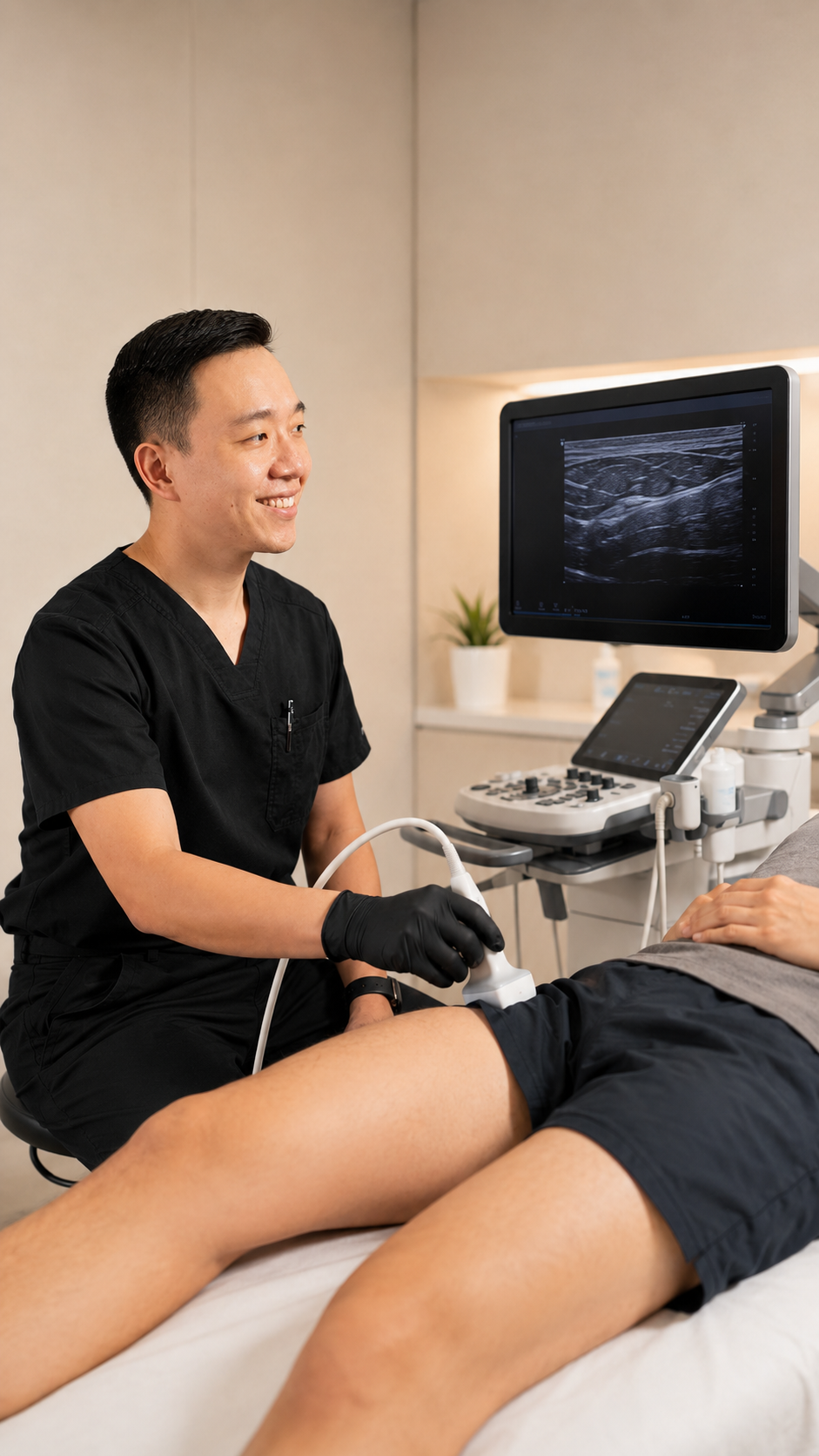
Diagnostic musculoskeletal ultrasound uses sound waves to visualize many superficial muscles, tendons, ligaments, joints, nerves, and other soft tissues.
One advantage is that structures can often be examined in real time while the patient moves.
Ultrasound may also be used during certain procedures to visualize the treatment area and guide needle placement.
At Ask Dr. Hu, musculoskeletal ultrasound and ultrasound-guided procedures may be used when clinically appropriate. Ultrasound can help evaluate certain conditions and guide treatment, but it does not replace MRI or X-ray in every situation.
Diagnostic Imaging and Ultrasound Guidance Are Not the Same Thing
Patients sometimes hear that an injection will be performed with ultrasound guidance and assume this means they have already received all necessary diagnostic imaging.
These are related but different uses of ultrasound.
Diagnostic ultrasound is performed to evaluate anatomy and look for findings that may help explain symptoms.
Ultrasound guidance is used during a procedure so the physician can visualize the target, needle, and surrounding structures in real time.
A physician may use ultrasound guidance during an injection even when the patient's diagnosis was established through examination, X-ray, MRI, previous records, or another method.
Conversely, diagnostic ultrasound may sometimes be performed without any injection being planned.
Can Imaging Show the Exact Cause of Pain?
Not always.
Imaging can identify structural findings, but a finding on an MRI or X-ray does not automatically prove that it is responsible for a patient's symptoms.
This is one reason imaging should be interpreted alongside:
Your symptoms
Physical examination findings
Location of pain
Functional limitations
Mechanism of injury
Neurological findings
Response to previous treatment
Imaging abnormalities can sometimes be present even when they are not clinically responsible for the patient's pain. For example, age-related or degenerative findings are frequently identified on spinal imaging and may not necessarily explain the person's symptoms.
The goal is therefore not simply to find something abnormal on a scan. The goal is to determine whether the imaging finding makes sense in the context of the patient's overall clinical picture.
What If I Already Have an MRI or X-Ray?
Bring it with you—or provide access to the report and images if possible.
Previous imaging can be extremely helpful.
During an evaluation, your physician may review:
X-rays
MRI studies
CT scans
Ultrasound examinations
Radiology reports
Previous procedure records
Orthopedic or specialist consultations
You do not necessarily need to repeat imaging simply because it was performed somewhere else.
Whether older imaging remains useful depends on when it was obtained, whether your symptoms have changed, whether there has been a new injury, and what clinical question needs to be answered.
Ask Dr. Hu routinely considers available previous records and imaging as part of a comprehensive pain evaluation.
When Should Imaging or Medical Evaluation Be More Urgent?
Most musculoskeletal pain is not an emergency, but certain symptoms require prompt medical evaluation.
Seek urgent or emergency medical care for symptoms such as:
Severe trauma or suspected fracture
Sudden or rapidly progressive weakness
New paralysis
New loss of bowel or bladder control
Numbness in the groin or saddle region
Severe pain associated with fever or significant illness
Chest pain or difficulty breathing
Rapidly worsening swelling
Signs of a serious infection
Other sudden or severe neurological symptoms
These situations should not wait for a routine pain-management appointment.
So, Do I Need Imaging Before Starting Pain Treatment?
Maybe—but not necessarily.
The most appropriate sequence is usually:
Evaluation → suspected diagnosis → determine whether imaging will change management → choose treatment.
Not:
Pain → automatically order MRI → begin treatment.
Some patients can begin conservative care after a thorough medical evaluation without advanced imaging.
Others may need X-rays, MRI, diagnostic ultrasound, or another study before treatment can safely and appropriately proceed.
The decision depends on the individual clinical situation.
If you are experiencing persistent joint, muscle, tendon, nerve, neck, or back pain, a detailed evaluation can help determine whether imaging is necessary and which type would provide the most useful information.
You can learn more about the evaluation process and available treatment options in our Integrative Pain Management Resource Center or explore integrative pain management services at Ask Dr. Hu.
Why You Can Trust This Information
Medical imaging should be selected based on the patient's symptoms and the clinical question being investigated rather than ordered automatically.
The American College of Radiology Appropriateness Criteria provide evidence-based recommendations for choosing appropriate imaging based on specific clinical scenarios. The criteria are developed and periodically reviewed by multidisciplinary expert panels.
The American Academy of Family Physicians similarly emphasizes appropriate, selective diagnostic imaging and recommends avoiding unnecessary imaging in certain uncomplicated musculoskeletal presentations, including acute low back pain without concerning clinical findings.
At Ask Dr. Hu, educational content is designed to help patients understand how medical decisions are made while recognizing that imaging and treatment recommendations must ultimately be individualized.
About the Author
Linh Ngo, NMD, is an Arizona-licensed naturopathic physician at Ask Dr. Hu with a clinical focus that includes integrative pain management, naturopathic treatment modalities, supportive care, and healthy aging. Her approach emphasizes careful evaluation, individualized treatment planning, and helping patients understand the potential benefits, limitations, and alternatives of their treatment options.
Learn more about Dr. Linh Ngo and the physicians at Ask Dr. Hu.
Published August 2026 | Medically reviewed August 2026
This article is intended for general educational purposes and does not replace individualized medical evaluation, diagnosis, or treatment. Imaging and treatment recommendations depend on each patient's symptoms, examination findings, medical history, and clinical circumstances.