Do I Need an Appointment Before Medical Forms Can Be Completed?
Written by YiQiu Hu, NMD
Arizona-licensed naturopathic physician and concierge medicine provider
Published July 2026 | Medically reviewed July 2026
Usually, a physician appointment is required before medical forms can be completed. This is especially true when you are a new patient, the physician has not recently evaluated the relevant condition, your symptoms have changed, or the form requires a physical examination or professional medical opinion.
However, a separate appointment may not always be necessary. A physician may sometimes be able to complete a simple follow-up form using information from a recent visit and current medical records.
The appropriate process depends on the type of form, the questions being asked, the medical evidence available, and whether the physician has enough current information to complete the documentation responsibly.
Patients who need assistance may learn more about our medical documentation services in Arizona.


Completing medical paperwork involves more than adding a signature to a form.
When a physician signs a document, the physician is confirming that the information is accurate and supported by an appropriate medical assessment. Depending on the form, the physician may be asked to verify:
A diagnosis or medical condition
The date the condition began
Current symptoms
Previous and ongoing treatment
Physical or cognitive limitations
The effect of the condition on work, school, or daily activities
Recommended restrictions or accommodations
The anticipated duration of a limitation
Whether a person can safely return to work or participate in an activity
Whether treatment, equipment, leave, or an accommodation is medically necessary
An appointment gives the physician an opportunity to review these questions, evaluate your current condition, clarify missing information, and determine which statements can be medically supported.
For a broader explanation of how forms, letters, certifications, and medical opinions are prepared, visit our complete guide to medical documentation.
When Is an Appointment Usually Required?
An appointment will generally be needed in the following situations.
You Are a New Patient
A physician usually cannot complete medical paperwork for someone who has never been evaluated. Establishing care allows the physician to understand your medical history, current symptoms, treatment, and functional limitations.
Records from another healthcare professional can be helpful, but they may not replace the need for an independent evaluation.
The Condition Has Not Been Evaluated Recently
Even when you are an established patient, an appointment may be necessary if the relevant condition has not been discussed recently.
Medical circumstances can change over time. A previous diagnosis or restriction may no longer accurately reflect your current condition, ability to work, or need for accommodation.
Your Symptoms or Limitations Have Changed
Updated documentation may be necessary when symptoms improve, worsen, or begin affecting you differently.
For example, a new appointment may be required when you are requesting:
An extension of medical leave
Additional work restrictions
A change in an accommodation
A revised return-to-work date
An updated disability certification
Clearance after an injury, surgery, or hospitalization
The physician must evaluate whether the requested changes are consistent with your current medical condition.
The Form Requires a Detailed Medical Opinion
Complex documentation commonly requires a dedicated appointment and review of relevant records.
Examples may include:
Family and Medical Leave Act paperwork
Intermittent FMLA certification
Short-term or long-term disability forms
Workplace accommodation requests
Fitness-for-duty evaluations
Medical-necessity letters
VA disability medical opinions
Detailed functional limitation assessments
These requests often ask the physician to explain not only the diagnosis, but also how the condition affects specific work duties, activities, or daily functions.
A Physical Examination Is Required
Some forms cannot be completed responsibly through records or conversation alone.
An in-person appointment may be required for:
Employment physicals
School or sports physicals
Return-to-work clearance
Fitness-for-duty examinations
Evaluation of strength or range of motion
Neurological or musculoskeletal limitations
Cardiovascular or respiratory assessments
Safety-sensitive occupational clearance
Additional laboratory testing, imaging, immunization records, specialist evaluation, or other testing may also be required before clearance can be provided.
The Request Involves Past Dates
Patients occasionally request a work or school note for an illness that occurred before they contacted the physician.
A physician may document the history you report, but it may not be possible to independently confirm that you were medically unable to work or attend school on a past date when no evaluation occurred.
An appointment may still be helpful, but it does not guarantee that a retroactive excuse, restriction, or disability period can be certified.
Why Is an Appointment Often Necessary?
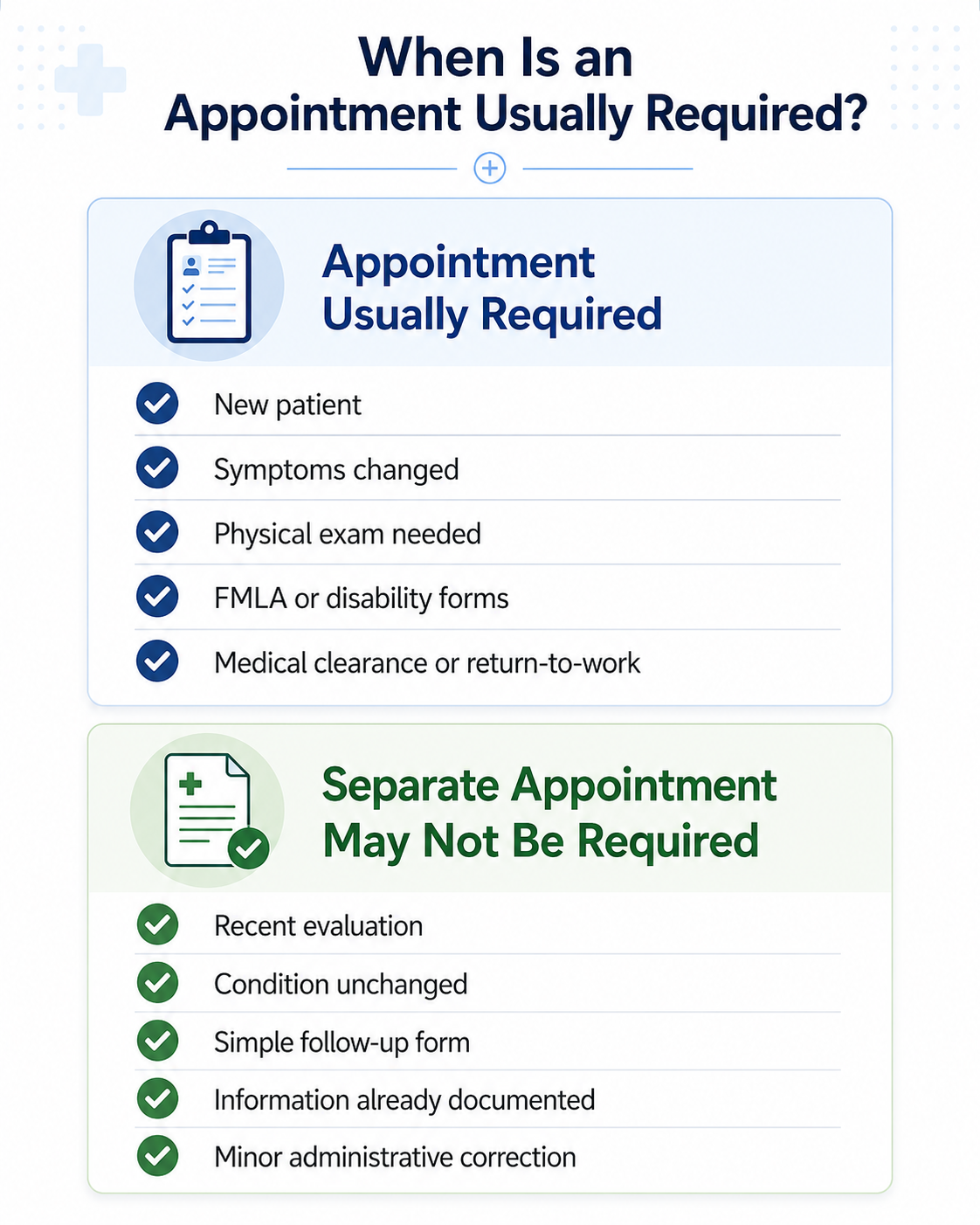
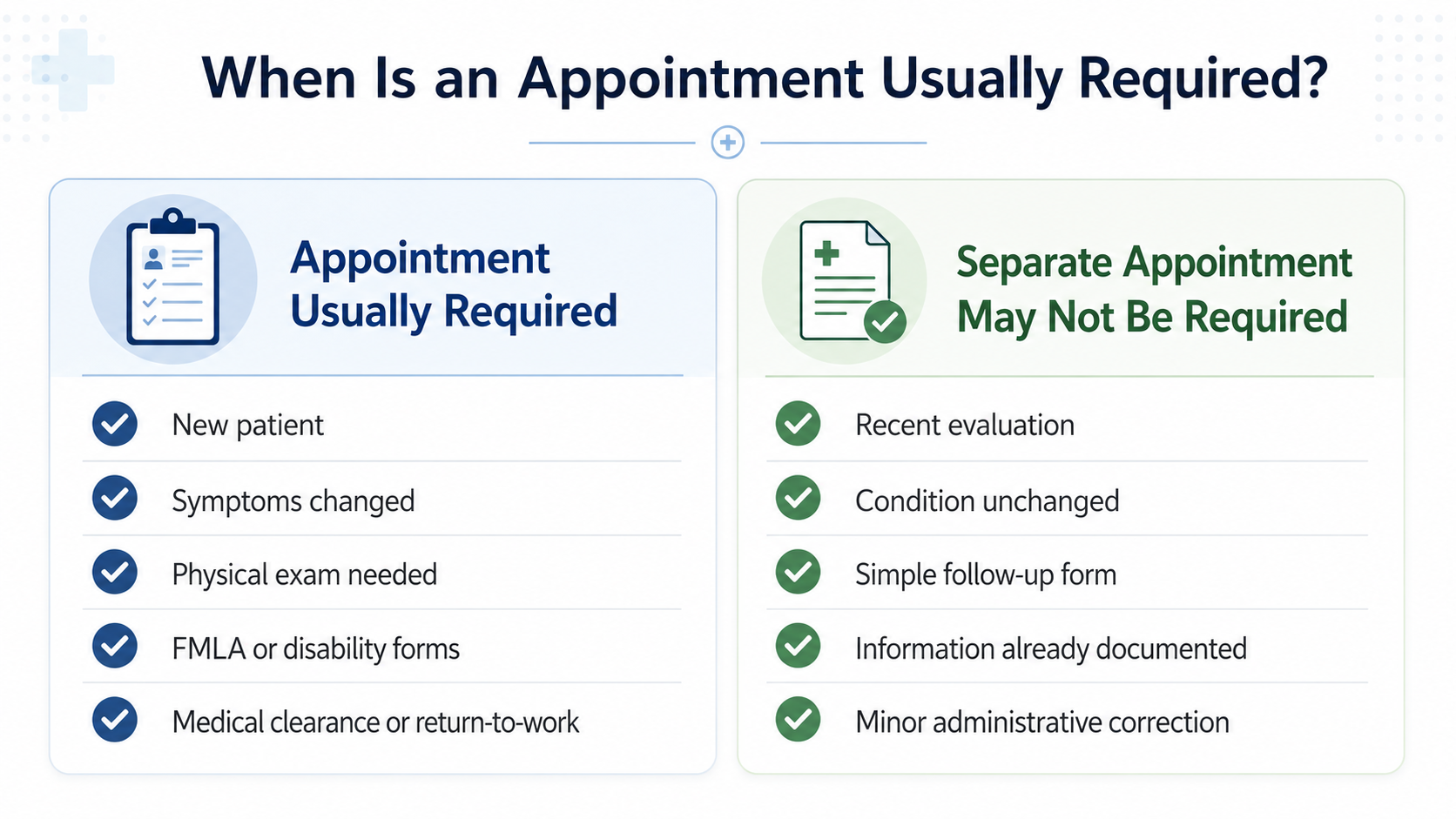
When Might a Separate Appointment Not Be Necessary?
A new appointment may not be required when the physician already has enough recent and relevant information to answer the questions accurately.
This may be possible when:
You were recently evaluated for the same condition
The requested form is a straightforward follow-up
There have been no meaningful changes in your symptoms or limitations
The form only asks for facts already documented in your medical record
A previous form needs a minor administrative correction
An employer, school, or insurer requests clarification of recently completed documentation
The physician has current examination findings and supporting records
Even in these situations, the physician must review the form before deciding whether it can be completed without another visit.
A form that appears simple to the patient may request a new medical conclusion, updated restrictions, or information that was not addressed during the previous appointment.
Can the Appointment Be Completed Through Telemedicine?
Some medical-documentation appointments can be conducted through secure telemedicine.
A virtual appointment may be appropriate when the request can be evaluated using:
A detailed medical history
Current symptoms
Existing medical records
Laboratory or imaging reports
Specialist notes
Previously documented examination findings
A discussion of work, school, or daily activities
Certain work notes, accommodation letters, follow-up forms, medical-record reviews, and portions of FMLA or disability evaluations may be appropriate for telemedicine.
An in-person visit may be necessary when the physician must directly evaluate strength, mobility, balance, breathing, heart function, neurological findings, physical limitations, or another condition that cannot be assessed adequately through a virtual visit.
The physician will determine the appropriate appointment format after reviewing the form and its requirements.
What Happens During a Medical Documentation Appointment?
The physician will generally begin by reviewing the complete form, the organization’s instructions, and the submission deadline.
The appointment may then include discussion of:
Your medical history
The relevant diagnosis or symptoms
When the condition began
Previous and current treatment
Medications and possible side effects
Activities you are unable to perform
Your essential work or school responsibilities
The type and duration of leave requested
Requested restrictions or accommodations
Your expected recovery or reassessment timeline
The physician may also review medical records, laboratory results, imaging reports, hospital records, surgical reports, specialist notes, or other supporting evidence.
When necessary, a physical examination, additional testing, follow-up evaluation, or specialist referral may be recommended before the documentation can be completed.
What Should I Provide Before the Appointment?
Providing the complete request in advance can help the physician determine what type of evaluation will be necessary.
You should provide:
The complete form
All instructions from the receiving organization
The submission deadline
The name and contact information of the recipient
A job description or list of essential duties when applicable
Relevant medical records
Laboratory and imaging reports
Hospital, surgical, or specialist records
A current medication list
Previous forms related to the same condition
Dates of missed work, school, appointments, or treatment
Complete any sections specifically designated for the patient, but do not complete or alter sections reserved for the healthcare professional.
Our patient’s guide to requesting medical documentation provides a step-by-step explanation of how to prepare and reduce avoidable delays.
Does Scheduling an Appointment Guarantee That the Form Will Be Completed?
No. An appointment allows the physician to evaluate the request, but it does not guarantee that every requested statement can be certified.
A physician may be unable to complete all or part of a form when:
There is not enough medical evidence
The requested statement conflicts with the clinical findings
The physician has not evaluated the relevant condition
Past events cannot be independently verified
The form requires a particular specialist or designated examiner
Necessary testing has not been completed
The requested restriction is not medically supported
The request falls outside the physician’s professional scope
The physician cannot reach the requested conclusion with reasonable clinical confidence
When the requested language cannot be supported exactly as written, the physician may be able to provide a more limited statement describing the findings that can be verified.
The physician provides an objective medical assessment. The employer, school, insurance company, disability carrier, government agency, or other receiving organization makes the final decision regarding approval.
What Types of Forms Can a Physician Complete?
Depending on the patient’s condition and the evaluation performed, medical documentation may include:
Work and school notes
Return-to-work or return-to-school letters
Work restrictions
FMLA paperwork
Disability forms
Workplace accommodation letters
Medical-necessity letters
Physical examination forms
Medical clearance documentation
VA-related medical documentation
Referral and care-coordination letters
Read more about the types of medical documentation a physician may complete.
Frequently Asked Questions
-
Records from another healthcare professional can provide valuable supporting information. However, the physician signing the form may still need to perform an independent evaluation before confirming a diagnosis, limitation, restriction, or medical opinion.
-
Sometimes. A straightforward form may be completed after the initial evaluation when sufficient information and supporting evidence are available. Complex documentation may require additional records, testing, or follow-up.
-
A physician may document the history reported by the patient but may not be able to verify that the patient was medically unable to work or attend school on a past date when no evaluation occurred.
-
You may need evaluation by an appropriate specialist, surgeon, occupational medicine provider, mental health professional, or another designated examiner. Your physician may still be able to provide supporting records or a referral summary.
-
No. Request documentation as early as possible. Complex forms may require record collection, an appointment, physical examination, diagnostic testing, or specialist involvement.
The Bottom Line
Most new or complex medical-form requests require an appointment before they can be completed. An appointment is particularly important when the physician must evaluate a new condition, update restrictions, perform a physical examination, or provide a detailed professional opinion.
A separate visit may not be necessary when the physician recently evaluated the same condition and already has sufficient current information. The physician must review each request individually before determining what type of appointment or additional evidence is required.
Ask Dr. Hu provides individualized medical evaluations and physician documentation for employment, disability, military, educational, insurance, and healthcare-related needs throughout Arizona.
To discuss your request, contact Ask Dr. Hu and provide a general description of the documentation you need. Do not submit private medical records through an unsecured general contact form. The practice can provide appropriate instructions for submitting protected health information securely.
This article is intended for general educational purposes and does not constitute medical, legal, employment, disability, or insurance advice. Documentation requirements and eligibility decisions are determined by the applicable employer, school, insurer, benefit plan, government agency, or other receiving organization.
When to Schedule a Medical Documentation Appointment
Consider scheduling a medical documentation appointment when an employer, school, insurer, government agency, or other organization asks for a physician-completed form or supporting medical letter. An appointment may also be appropriate if your documentation requires an updated assessment of your symptoms, treatment history, or functional limitations. Scheduling early allows time to review the form’s requirements, obtain relevant medical records, and determine whether a virtual consultation, in-person examination, or specialist evaluation is needed.