Do I Need to Fast Before a Specialty Lab Test?
Written by YiQiu Hu, NMD
Arizona-licensed naturopathic physician and virtual concierge medicine provider
Published August 2026 | Medically reviewed August 2026
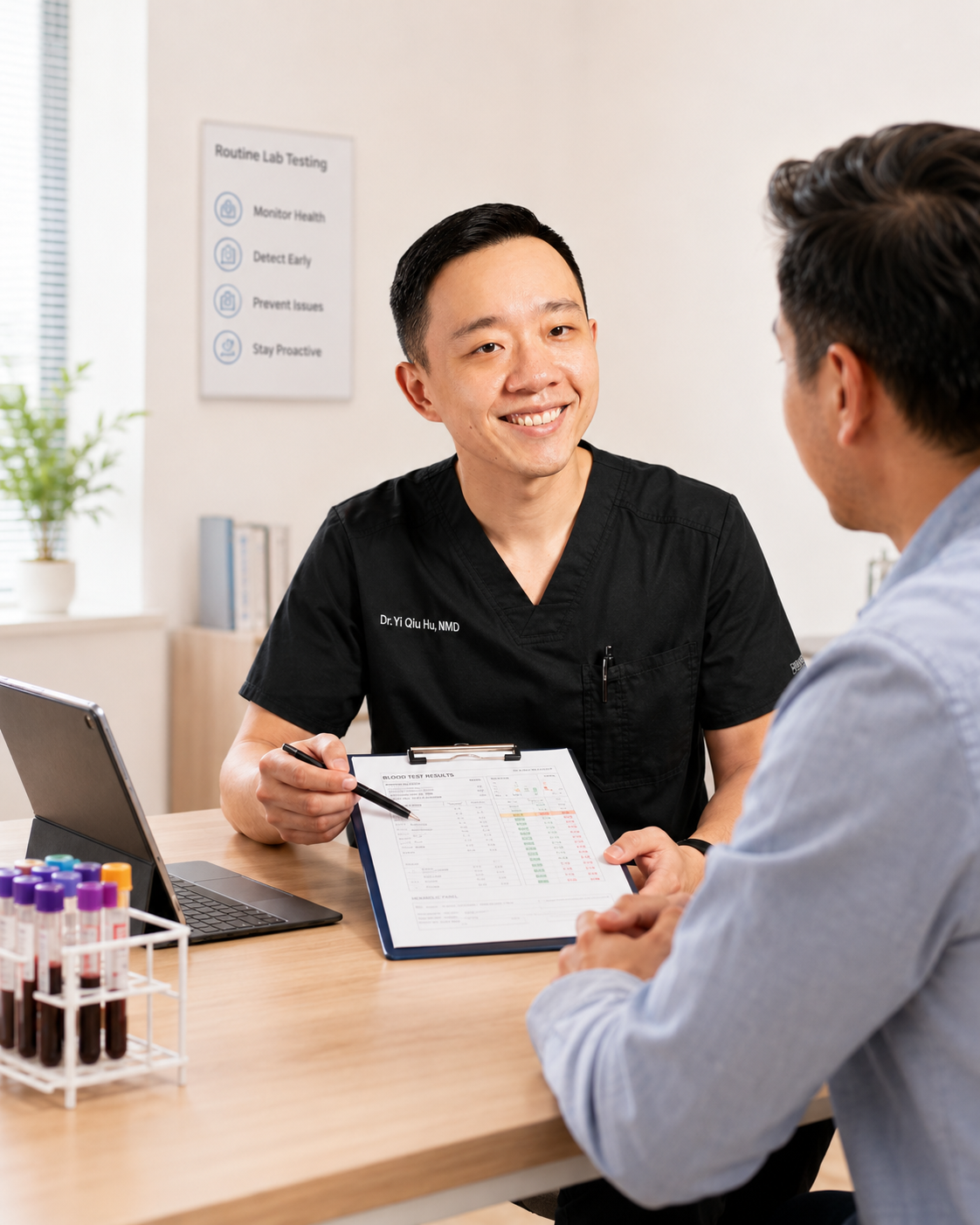

The short answer: sometimes. Some specialty laboratory tests require fasting, while many others do not. Whether you should fast depends on the specific test, the biomarkers being measured, the type of sample being collected, and the laboratory performing the analysis.
For that reason, you should follow the preparation instructions provided for your individual test rather than assuming that every specialty laboratory test requires an overnight fast.
If you are preparing for testing through Ask Dr. Hu, we can review the collection requirements with you before your test. You can also learn more about the different types of testing available in our Specialty Laboratory Testing Resources.
Why Would a Specialty Lab Test Require Fasting?
Eating changes your body's short-term metabolic state.
After a meal, glucose, insulin, triglycerides, amino acids, vitamins, minerals, and other substances may temporarily rise or fall in the bloodstream. If a laboratory test is designed to evaluate one of these markers under fasting conditions, eating beforehand can influence the result.
This is why fasting may be particularly important when a specialty blood panel includes markers related to:
Glucose regulation
Insulin
Insulin resistance
Triglycerides
Certain lipid measurements
Some metabolic markers
Certain nutrient or chemistry measurements
For example, a calculation such as HOMA-IR uses fasting glucose and fasting insulin, making the fasting state relevant to interpretation.
However, this does not mean every specialty blood test requires fasting.
How Long Do I Need to Fast?
When fasting is required for a blood test, a common fasting period is approximately 8 to 12 hours, although the exact requirement depends on the laboratory and test being performed.
Your specific instructions take priority.
If you are told to complete a 10-hour fast and your blood draw is scheduled for 8:00 a.m., for example, you would generally finish eating by approximately 10:00 p.m. the night before.
Morning appointments can make fasting easier because much of the fasting period occurs while you are sleeping.
Can I Drink Water While Fasting?
For most fasting blood tests, plain water is allowed and is often preferable to becoming dehydrated.
Staying reasonably hydrated may also make it easier to obtain a blood sample.
Unless your test instructions specifically state otherwise, the safest approach during a laboratory fast is generally to stick with plain water rather than assuming that other calorie-free beverages are acceptable.
Coffee, tea, flavored water, energy drinks, juice, soda, creamers, sweeteners, and other beverages may affect certain tests.
If your laboratory specifically permits something other than water, follow those instructions.
Do All Specialty Blood Tests Require Fasting?
No.
Many specialty blood tests evaluate antibodies, genetics, immune markers, infectious disease markers, or other measurements that may not require fasting.
For example, certain infectious-disease specialty panels may specifically state that patients can maintain their normal diet before collection.
However, two tests that both require blood can have completely different preparation requirements.
The specific assay matters more than the fact that it is a blood test.
This is one reason specialty testing should ideally be selected deliberately rather than ordering large panels without considering how the results will be interpreted.
If you are still deciding which type of testing may be appropriate, visit our Specialty Laboratory Testing Services.
What About Urine Specialty Tests?
Urine testing has its own preparation requirements.
Some specialty urine tests do not require fasting at all, while others may recommend specific timing or dietary preparation.
Instructions may address issues such as:
First-morning versus random urine
How much water to drink before collection
Foods to avoid
Supplements to avoid
Medications that may influence results
Timing relative to meals
Whether multiple urine samples are required
Drinking excessive amounts of water immediately before some urine collections can also produce an overly diluted sample.
Therefore, do not assume that drinking large amounts of water will improve your urine specimen. Follow the kit instructions instead.
Do I Need to Fast Before a Stool Test?
Fasting is not a universal requirement for specialty stool testing.
Stool tests are commonly used to evaluate gastrointestinal microorganisms, digestive markers, inflammatory markers, or other gastrointestinal findings. Collection requirements depend on the laboratory and the specific panel.
Preparation may involve instructions concerning:
Probiotics
Antibiotics
Antimicrobial medications
Digestive enzymes
Laxatives
Supplements
Timing of collection
Storage and shipping
Even when fasting is unnecessary, following the collection instructions carefully is important because incorrect collection, contamination, storage, or shipping can affect specimen quality.
For a broader explanation of specialty gastrointestinal testing, visit our Specialty Laboratory Testing Resources.
What About Saliva Testing?
Saliva testing may require preparation that is different from traditional fasting.
Depending on the test, you may be instructed to avoid eating, drinking certain beverages, brushing your teeth, using mouthwash, smoking, exercising, or taking certain supplements for a period before collection.
Some hormone tests also require samples at specific times of day because hormone levels can follow daily biological rhythms.
When several samples are required throughout the day, correct timing can be just as important as whether you have eaten.
Can I Take My Medications Before a Specialty Lab Test?
Do not stop a prescription medication simply because you are having laboratory testing unless your healthcare provider specifically instructs you to do so.
Medications can affect certain laboratory measurements, but discontinuing a medication without medical guidance can create unnecessary risk.
The same principle applies to over-the-counter medications.
Make sure your physician knows what you are taking before testing so the preparation instructions and eventual laboratory results can be interpreted appropriately.
What About Vitamins and Supplements?
Supplements deserve special attention with specialty testing.
Vitamins, minerals, herbal products, amino acids, hormones, and other supplements can influence certain laboratory results.
Whether you should continue or temporarily avoid a supplement depends on:
What is being measured
Why the test is being ordered
The laboratory methodology
Your medical history
The supplement involved
Do not automatically discontinue everything.
Instead, review your medications and supplements with the ordering physician and follow the instructions for your particular test.
What If I Accidentally Eat Before a Fasting Test?
Tell your physician or the laboratory.
Do not simply complete the test and assume that it will not matter.
Depending on what you ate, when you ate it, and which biomarkers are being measured, your physician may recommend:
Proceeding with the test and documenting that you were not fasting
Interpreting certain measurements as nonfasting
Delaying part of the testing
Rescheduling the collection
Being accurate about your fasting status is much more useful than trying to hide an accidental meal or beverage.
Should I Fast Anyway Just to Be Safe?
Usually, no.
Fasting when you were not instructed to fast is not necessarily better.
Laboratory results are most useful when the collection conditions match the conditions under which the test is intended to be performed and interpreted.
An unnecessary fast may also be uncomfortable or inappropriate for certain patients.
Rather than fasting automatically, verify the preparation requirements beforehand.
This is especially important for people who are pregnant, have diabetes or blood sugar problems, take glucose-lowering medications, have certain chronic medical conditions, or have previously experienced problems while fasting. Individualized medical instructions should take priority.
How Should I Prepare the Day Before Specialty Testing?
Preparation varies significantly between tests, but a good general approach is to review your instructions before the day of collection, not the morning of the test.
Confirm:
Whether fasting is required
Exactly how many hours you should fast
Whether plain water is permitted
Whether there are food restrictions
Whether alcohol should be avoided
Whether exercise should be limited
Whether medications or supplements require special instructions
Whether the sample must be collected at a certain time
Whether you are collecting blood, urine, stool, saliva, or multiple specimen types
How the specimen should be stored and returned
For more general preparation information, you may also find our guide to Understanding Laboratory Testing helpful.
The Bottom Line
You do not automatically need to fast before every specialty lab test.
Some specialty blood tests require an overnight fast, particularly when fasting glucose, insulin, triglycerides, or certain metabolic measurements are important. Other blood tests may have no fasting requirement at all.
Urine, stool, saliva, and at-home specialty testing may have completely different preparation instructions involving timing, hydration, diet, medications, supplements, or specimen handling.
The best rule is simple:
Follow the instructions for the specific test you are actually taking.
If anything is unclear, ask your physician before collecting the sample. Proper preparation can reduce avoidable testing errors and make the results more clinically useful.
If you are considering specialty testing and would like help determining which tests may be appropriate, learn more about our Specialty Laboratory Testing Services or contact Ask Dr. Hu.
Medical Review & Editorial Standards
This article was written for patient education by YiQiu Hu, NMD, an Arizona-licensed naturopathic physician.
Information regarding fasting and laboratory preparation was reviewed alongside patient-education guidance from the National Library of Medicine's MedlinePlus, MedlinePlus guidance on preparing for laboratory tests, and laboratory specimen-preparation resources from Labcorp.
Because specialty laboratory requirements differ by assay and specimen type, patients should also follow the collection instructions supplied by the laboratory performing their test. Specialty laboratories such as Vibrant Wellness provide test- and specimen-specific collection instructions for blood, urine, stool, saliva, and other collection methods.
Laboratory testing should be interpreted in the context of symptoms, medical history, medications, examination findings, and other clinically relevant information. A laboratory result by itself does not necessarily establish a diagnosis.
This information is intended for general educational purposes and does not replace individualized medical advice, diagnosis, or treatment.
Last medically reviewed: August 2026
About the Author
YiQiu Hu, NMD
Dr. YiQiu Hu is an Arizona-licensed naturopathic physician and founder of Ask Dr. Hu. His clinical work includes concierge medicine, preventive healthcare, health optimization, diagnostic evaluation, laboratory testing and interpretation, and individualized treatment planning.
His approach emphasizes thoughtful medical evaluation, clear explanations, evidence-informed care, and using laboratory testing when the results are likely to provide meaningful information that can help guide patient care.