How Concierge Medicine Works: Everything You Need to Know Before Joining
Written by YiQiu Hu, NMD
Arizona-licensed naturopathic physician and concierge medicine provider
Published July 2026 | Medically reviewed July 2026


Introduction
Many patients are attracted to concierge medicine because they want more time with their physician, easier communication, and a more personalized healthcare experience. However, before paying a membership fee, it is important to understand exactly how the model works.
What happens after you join? How do you contact your physician? Are appointments included? Can you still use your health insurance? What happens when you need laboratory testing, a specialist, urgent medical attention, or hospital care?
The answers vary because every concierge practice establishes its own services, communication policies, fees, and limitations.
In general, concierge medicine is a membership-based healthcare model in which patients pay a recurring fee for enhanced access to a physician and a more relationship-centered approach to medical care. You can read our broader physician guide to learn more about what concierge medicine is.
This article focuses on the practical side of the model: how membership begins, how ongoing care is delivered, what the membership may cover, and what patients should clarify before joining.
How Does Concierge Medicine Work?
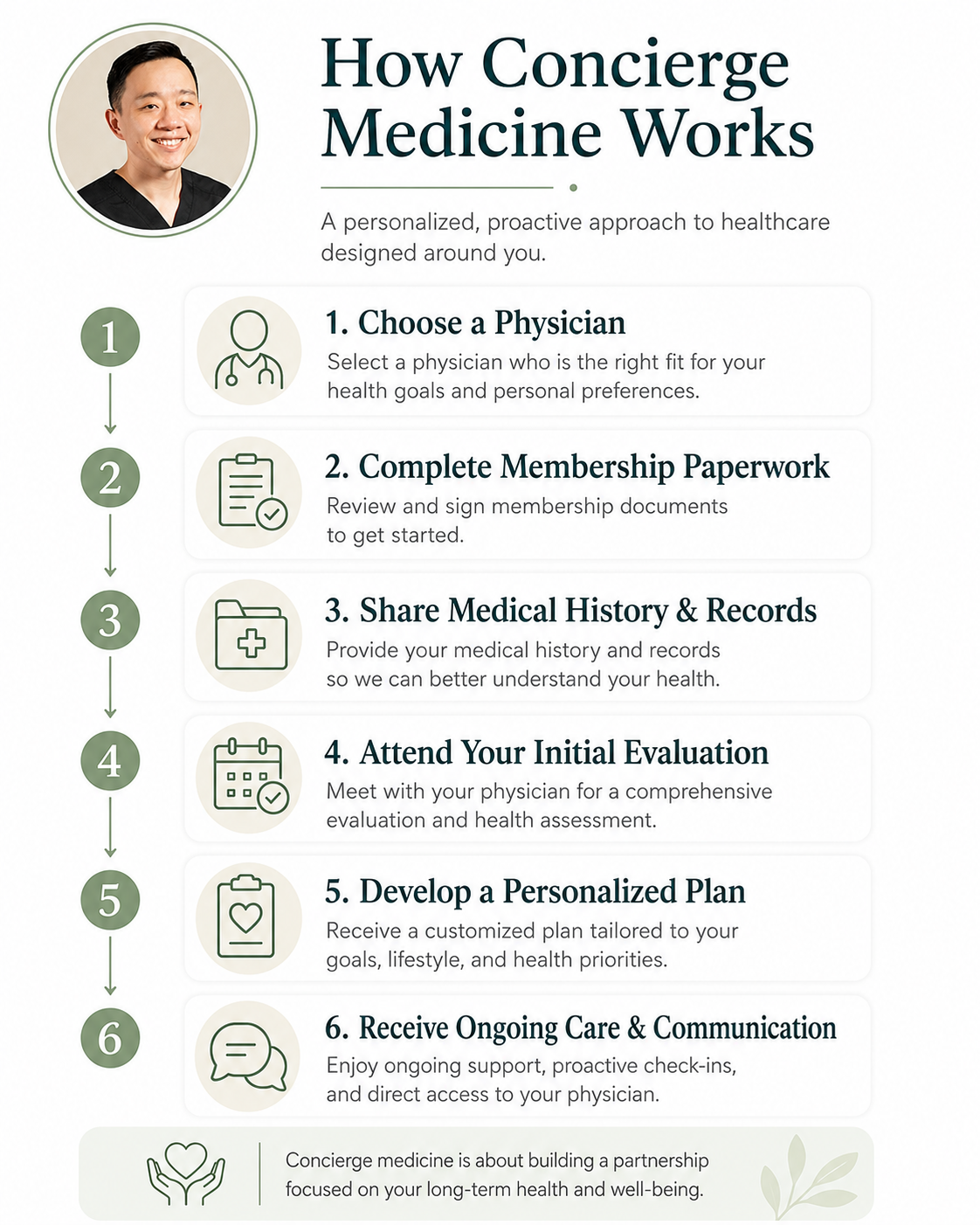
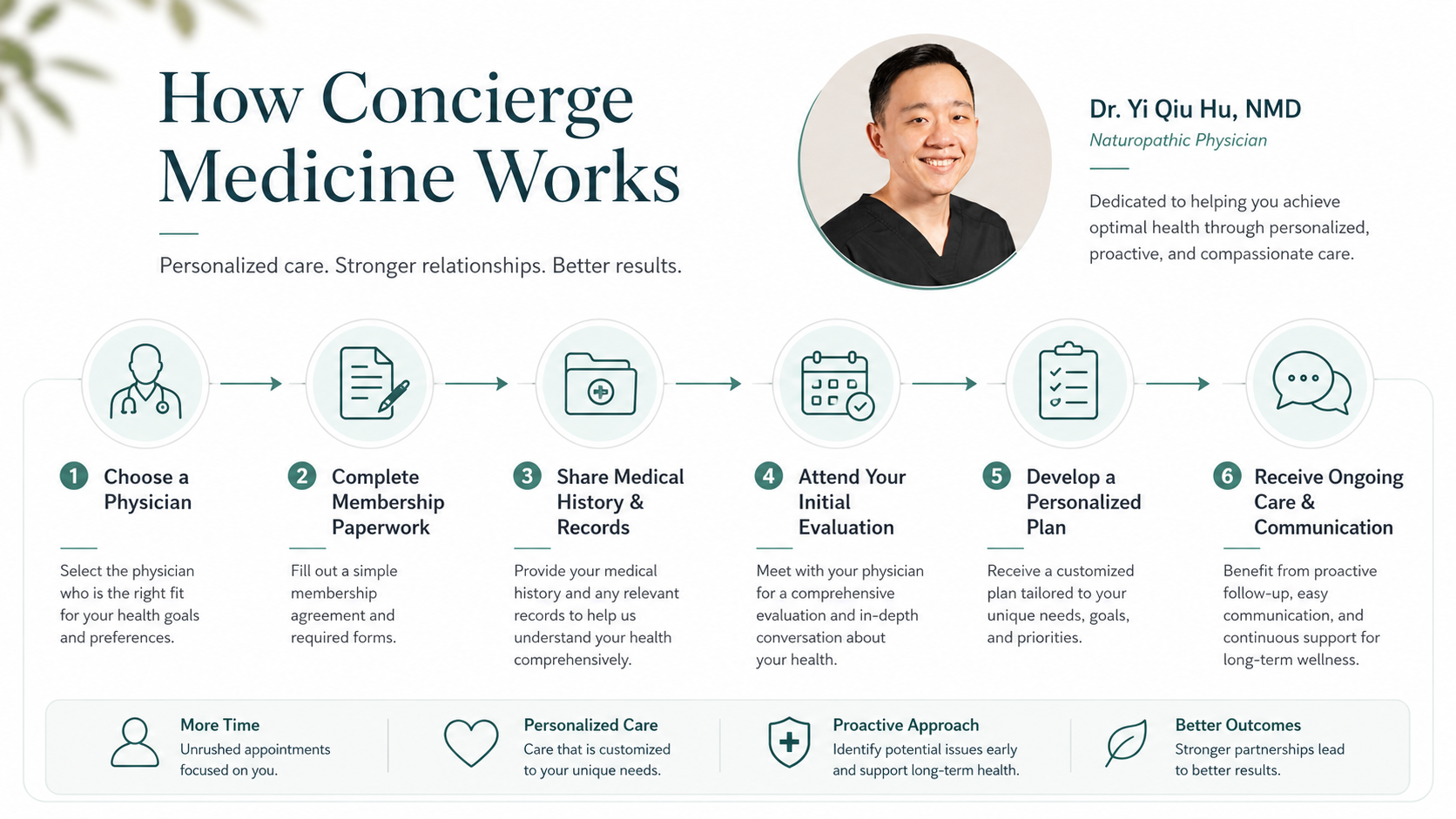
Concierge medicine generally works through a monthly or annual membership arrangement.
The membership fee helps the practice maintain a smaller patient panel and provide services that may be difficult to offer within a traditional, high-volume medical practice. Depending on the practice, these services may include longer appointments, direct physician communication, telemedicine, preventive health planning, chronic disease management, laboratory review, medication management, and care coordination.
Membership does not mean that every medical service is automatically included. It also does not eliminate the need for health insurance, emergency care, specialists, hospitals, imaging centers, pharmacies, or other healthcare professionals.
The simplest way to understand the model is to look at what typically happens at each stage of the patient experience.
Step 1: You Evaluate the Practice Before Joining
The process should begin before you sign a membership agreement or make a payment.
Patients should first determine whether the physician’s services, availability, communication style, and clinical approach align with their needs. A concierge practice should clearly explain:
The membership fee
What services are included
What services cost extra
How appointments are scheduled
How patients communicate with the physician
Whether after-hours communication is available
Whether telemedicine is offered
When in-person examinations are required
How insurance is handled
What happens during emergencies
How membership may be canceled
Do not choose a practice based only on the promise of increased access. The quality of the physician-patient relationship, the physician’s qualifications, the services offered, and the clarity of the membership agreement are equally important.
Our patient’s guide to joining a concierge medicine practice provides additional guidance for comparing practices and deciding whether membership fits your needs.
Step 2: You Complete Enrollment and Membership Paperwork
Once you decide to join, the practice will generally ask you to complete registration documents and a membership agreement.
The enrollment process may include:
Basic contact and demographic information
Medical history forms
Current medications and supplements
Medication allergies
Surgical and hospitalization history
Family medical history
Communication preferences
Telemedicine consent
Privacy and HIPAA forms
Financial policies
Membership terms and limitations
Authorization to request previous medical records
Read the membership agreement carefully before signing it. Pay particular attention to billing frequency, cancellation requirements, refund policies, communication boundaries, excluded services, and whether the physician will serve as your primary care provider.
You should receive an opportunity to ask questions about any part of the agreement that is unclear.
Step 3: Your Previous Medical Information Is Collected
A concierge physician needs a complete understanding of your health history to provide coordinated and personalized care.
You may be asked to provide records from previous primary care physicians, specialists, hospitals, laboratories, imaging centers, and pharmacies. These records may include:
Recent office notes
Laboratory results
Imaging reports
Specialist evaluations
Immunization records
Medication history
Previous diagnoses
Hospital discharge summaries
Surgical records
Preventive screening results
Complete records are especially important if you have several medical conditions, take multiple medications, or receive care from more than one specialist.
Obtaining records can take time. Patients can often reduce delays by completing release forms promptly and providing the correct contact information for previous healthcare organizations.
Step 4: You Complete an Initial Comprehensive Evaluation
After enrollment, many concierge practices schedule an extended initial visit.
This appointment may be more detailed than a typical brief primary care visit because the physician is establishing a foundation for an ongoing relationship. The physician may review:
Your complete health history
Current symptoms and concerns
Existing diagnoses
Prescription medications
Vitamins and supplements
Nutrition and exercise habits
Sleep quality
Stress and mental well-being
Family medical history
Previous laboratory results
Preventive screenings
Personal health priorities
Short- and long-term goals
The physician may also determine whether you need a physical examination, updated vital signs, laboratory testing, imaging, medication changes, specialist referrals, or other evaluations.
Concierge medicine should not mean that every patient receives the same extensive list of tests. Testing and treatment should still be individualized according to your history, symptoms, risk factors, and clinical needs.
Step 5: You and Your Physician Develop a Healthcare Plan
Once the initial evaluation is complete, the physician can begin developing an individualized plan.
The plan may address several areas at the same time, including:
Current medical concerns
Chronic disease management
Medication monitoring
Preventive screenings
Laboratory follow-up
Nutrition and exercise
Weight management
Sleep and stress
Cardiovascular risk
Hormonal health
Healthy aging
Specialist care
Follow-up intervals
A personalized healthcare plan is not necessarily completed during one appointment. It may develop over several visits as the physician receives records, reviews laboratory data, evaluates your response to treatment, and learns more about your priorities.
The plan should also evolve as your health, lifestyle, medications, and goals change.
Step 6: You Receive Ongoing Physician Access
Direct access is one of the best-known features of concierge medicine, but the meaning of “access” varies substantially between practices.
Members may be able to communicate through:
Telephone calls
Text messaging
Email
Secure patient portals
Video appointments
In-person appointments
Before joining, ask who will respond to your messages, which communication methods are appropriate for medical questions, and what response time you should reasonably expect.
Direct communication does not necessarily mean instantaneous or unlimited availability. Physicians may be seeing other patients, performing procedures, traveling, sleeping, or managing personal responsibilities.
A responsible practice should establish clear expectations regarding routine messages, urgent concerns, evenings, weekends, vacations, and physician coverage.
Electronic communication should never be used as a substitute for emergency care. Call 911 or seek immediate in-person evaluation when you may be experiencing a medical emergency.
Step 7: Routine and Acute Concerns Are Addressed
Once you become an established patient, you may contact the practice when new health concerns develop.
Depending on the situation, the physician may:
Answer a brief question
Recommend home monitoring
Schedule a telemedicine appointment
Arrange an in-person evaluation
Order appropriate testing
Prescribe medication when medically appropriate
Recommend urgent care or emergency evaluation
Refer you to a specialist
Not every concern can be safely evaluated through a text message or telephone call. Symptoms such as chest pain, difficulty breathing, severe abdominal pain, neurological changes, significant injuries, or rapidly worsening illness may require immediate in-person assessment.
Concierge access can make it easier to determine the appropriate next step, but it does not remove the limitations of remote medical care.
Step 8: Chronic Medical Conditions Are Monitored Over Time
Concierge medicine can be particularly useful for patients who need ongoing monitoring rather than isolated, one-time visits.
Chronic care may involve:
Regular follow-up appointments
Medication adjustments
Blood pressure or glucose review
Laboratory monitoring
Symptom tracking
Lifestyle counseling
Specialist coordination
Reviewing outside recommendations
Updating treatment goals
Because the physician has more opportunities to follow the patient over time, subtle changes may be recognized earlier and treatment plans can be adjusted as new information becomes available.
No physician can guarantee that closer monitoring will prevent every complication. However, continuity and regular communication may make it easier to identify problems, address barriers, and keep the overall care plan organized.
Step 9: Preventive Care Becomes an Ongoing Process
Preventive care should involve more than ordering the same annual laboratory panel for every patient.
A personalized preventive plan may consider your age, sex, family history, previous results, lifestyle, medications, health conditions, and individual risk factors.
Preventive care may include:
Blood pressure monitoring
Cholesterol and diabetes screening
Age-appropriate cancer screening
Cardiovascular risk assessment
Medication review
Immunization recommendations
Nutrition counseling
Exercise planning
Sleep evaluation
Weight management
Fall-risk assessment
Bone-health evaluation
Lifestyle risk reduction
Rather than discussing prevention only during an annual visit, concierge medicine can make it part of the ongoing physician-patient relationship.
Learn more about the role of proactive medical care in our physician article, Preventive Healthcare: Why Prevention Is Better Than Treatment.
Step 10: Laboratory Testing Is Ordered and Reviewed When Appropriate
Laboratory testing may be used for routine screening, diagnostic evaluation, medication monitoring, chronic disease management, or preventive health planning.
Depending on the practice, the physician may:
Recommend appropriate tests
Send orders to a laboratory
Review prior laboratory results
Explain abnormal findings
Compare trends over time
Recommend follow-up testing
Adjust treatment according to the results
Ask whether the membership fee includes laboratory ordering, laboratory interpretation, blood-draw services, or the actual cost charged by the laboratory. These are different services and may be billed separately.
Health insurance may cover some laboratory tests when they meet the insurer’s requirements, but coverage depends on the plan, laboratory, diagnosis, deductible, and medical-necessity policies.
Our complete guide to laboratory testing explains how physicians use laboratory data and why results should be interpreted in the context of the individual patient.
Step 11: Specialist and Outside Care Are Coordinated
A concierge physician does not replace every specialist.
You may still need a cardiologist, endocrinologist, gastroenterologist, dermatologist, surgeon, physical therapist, mental-health professional, or another healthcare provider when a condition requires specialized expertise.
Your concierge physician may help by:
Identifying when specialist care is appropriate
Providing a referral
Sending relevant medical records
Explaining the reason for the referral
Reviewing the specialist’s recommendations
Reconciling medication changes
Ordering appropriate follow-up
Helping keep the overall treatment plan coordinated
Whether a referral is required by insurance depends on your health plan. Patients enrolled in an HMO or another managed-care plan should verify whether the concierge physician is recognized as their designated primary care provider for insurance purposes.
Step 12: Your Care Continues to Evolve
Concierge medicine is designed to function as an ongoing relationship rather than a series of unrelated appointments.
Over time, your physician should become more familiar with your medical history, communication preferences, previous treatment responses, risk factors, and personal goals.
Your care plan may be updated when:
New symptoms develop
A diagnosis changes
Medications are started or discontinued
Laboratory results change
You see a specialist
Your insurance changes
You move or travel
Your family or work responsibilities change
Your health priorities evolve
The value of continuity is not simply convenience. It is having a physician who can interpret new information within the context of your broader health history.
What Does the Concierge Membership Fee Pay For?
The membership fee generally supports the structure that allows the practice to provide enhanced access and more personalized care.
Depending on the practice, the fee may support:
A smaller patient panel
Longer appointments
Direct physician communication
Same-day or next-day scheduling when available
Telemedicine visits
Preventive health planning
Chronic disease management
Medication review
Laboratory interpretation
Care coordination
Administrative support
Evening or weekend availability
Ongoing follow-up between formal visits
Membership fees vary widely according to location, services, physician availability, panel size, and practice structure.
The lowest-priced practice is not automatically the best value, and the highest-priced practice does not necessarily provide the best care. Evaluate the complete package, including the physician’s qualifications, communication policies, clinical approach, limitations, and included services.
For a more detailed discussion, read How Much Does Concierge Medicine Cost?.
What Is Usually Not Covered by Concierge Membership?
Patients sometimes assume that paying a membership fee means all healthcare expenses are covered. This is usually not the case.
Services that may remain separate include:
Hospital care
Emergency-room services
Ambulance transportation
Specialist fees
Surgery
Imaging
Laboratory facility charges
Prescription medications
Medical devices
Physical therapy
Vaccinations
Certain office procedures
Services from outside healthcare organizations
Some practices include selected procedures or testing, while others bill separately. Review the agreement rather than assuming that a particular service is included.
Do You Still Need Health Insurance?
For most patients, yes.
Concierge medicine and health insurance serve different purposes. The membership generally pays for the access and services provided by the concierge practice. Insurance may still be needed for higher-cost or outside services such as:
Emergency care
Hospitalization
Surgery
Imaging
Specialist visits
Prescription medications
Cancer treatment
Rehabilitation
Medical equipment
Some concierge practices bill insurance for covered office services, while others do not bill insurance at all.
Before joining, ask whether the practice participates with your insurance, whether you will receive separate charges, and whether the physician can provide referrals that meet your plan’s requirements.
Do not cancel your health insurance solely because you join a concierge practice without carefully evaluating your potential financial exposure.


How Do Telemedicine and In-Person Care Work Together?
Telemedicine can make concierge care especially convenient for follow-up visits, medication discussions, laboratory reviews, lifestyle counseling, and concerns that can be evaluated safely through video or telephone communication.
However, telemedicine has limitations.
An in-person appointment may be needed when the physician must:
Perform a physical examination
Check vital signs
Evaluate an injury
Listen to the heart or lungs
Examine the abdomen, skin, ears, throat, or joints
Perform a procedure
Collect a specimen
Complete certain medical forms
Evaluate a condition that cannot be assessed remotely
A strong concierge model should use telemedicine when it is appropriate without allowing convenience to replace necessary in-person care.
Questions to Ask Before Joining
Before enrolling in any concierge practice, ask the following questions:
What is the monthly or annual membership fee?
Is there an enrollment fee?
What services are specifically included?
Which services require an additional charge?
How long are appointments?
How quickly can appointments generally be scheduled?
Can I communicate directly with the physician?
What communication methods are available?
What response time should I expect?
What happens during evenings and weekends?
Who covers the practice when the physician is unavailable?
Are telemedicine visits included?
Where are in-person visits performed?
Does the practice bill insurance?
Are laboratory fees included?
How are specialist referrals handled?
What happens if I am hospitalized?
What services are not provided?
How do I cancel the membership?
Are processed membership payments refundable?
Clear answers help prevent misunderstandings and allow you to compare practices fairly.
Warning Signs to Consider
Be cautious when a concierge practice:
Will not clearly explain its fees
Makes vague promises of unlimited availability
Guarantees specific medical outcomes
Recommends extensive testing without individual justification
Discourages necessary specialist or emergency care
Suggests that membership replaces health insurance
Does not explain who responds when the physician is unavailable
Pressures you to enroll immediately
Does not provide written membership terms
Avoids discussing cancellation or refund policies
A reputable practice should welcome reasonable questions and explain both the benefits and limitations of its model.
Who May Benefit From Concierge Medicine?
Concierge medicine may be helpful for patients who:
Want a long-term relationship with one physician
Prefer longer appointments
Value direct communication
Have several medical concerns to coordinate
Manage one or more chronic conditions
Want a stronger preventive-health focus
Travel frequently
Have a demanding work or family schedule
Need regular medication or laboratory monitoring
Feel that traditional appointments are too rushed
Want help navigating specialists and outside care
It may provide less value for someone who rarely uses medical care, primarily needs emergency services, or does not expect to use the access and ongoing support included in the membership.
The decision should be based on your healthcare needs, budget, expectations, and the specific practice being considered.
How Concierge Medicine Works at Ask Dr. Hu
At Ask Dr. Hu, our concierge model is designed for eligible Arizona patients who value direct physician communication, longer appointments, flexible scheduling, preventive health planning, chronic disease management, and coordinated medical care.
Our current concierge membership provides access to personalized care through virtual appointments and in-person care when appropriate. Members can communicate directly with their provider and receive ongoing support as health needs change.
We also offer selected individual medical services for patients who are not ready for membership or who need a specific evaluation.
Because concierge medicine has limitations, we clearly explain what our practice does and does not provide. We do not replace emergency departments, hospitals, specialists, or services that require a different level of care.
You can learn more about Dr. YiQiu Hu and Dr. Linh Ngo, our clinical backgrounds, and our approach to personalized naturopathic medical care.
Frequently Asked Questions
-
This depends on the practice. Some memberships include routine virtual and office visits, while other practices charge additional visit fees. Review the membership agreement for the exact services included.
-
Many practices provide direct communication, but availability and expected response times vary. Ask how routine, urgent, evening, weekend, and vacation coverage are handled.
-
A concierge physician may help evaluate some time-sensitive concerns and determine the appropriate next step. Serious or potentially life-threatening symptoms still require emergency services.
-
Yes, a licensed concierge physician may prescribe medication when it is medically appropriate, permitted by law, and within the physician’s scope of practice.
-
Usually, yes. A concierge physician can often work alongside your existing specialists and help coordinate the different parts of your care.
-
Many concierge memberships include or facilitate a comprehensive annual evaluation, but each practice structures this differently. Ask what the annual visit includes and whether an in-person examination is required.
-
Eligibility can depend on the services provided, how the membership is structured, current tax rules, and your individual plan. Consult the plan administrator or a qualified tax professional before assuming that the entire fee is eligible.
-
Cancellation policies vary. Review notice requirements, billing dates, minimum commitments, and refund policies before enrolling.
Final Thoughts
Concierge medicine is more than paying for faster appointments. When structured responsibly, it creates a healthcare relationship built around time, communication, continuity, prevention, and coordinated medical decision-making.
The experience begins with choosing the right physician and carefully reviewing the membership terms. After enrollment, the process usually includes comprehensive onboarding, development of a personalized plan, ongoing communication, preventive care, chronic disease management, laboratory monitoring, and coordination with outside healthcare professionals.
Before joining, make sure you understand exactly what the practice provides, what it does not provide, how your insurance will be used, and what each party should expect from the relationship.
To learn more about concierge membership for eligible patients throughout Arizona, review our membership information or contact Ask Dr. Hu with general questions about becoming a patient.
Arizona concierge medicine gives patients a more personalized alternative to traditional, high-volume healthcare through longer appointments, direct physician communication, and ongoing preventive care. At Ask Dr. Hu, eligible patients throughout Arizona can receive coordinated virtual care with in-person evaluations arranged when medically appropriate.