How Is Specialty Lab Testing Different from Routine Blood Work?
Written by YiQiu Hu, NMD
Arizona-licensed naturopathic physician and concierge medicine provider
Published August 2026 | Medically reviewed August 2026
Routine blood work provides a broad, foundational assessment of your health. Common tests may evaluate blood-cell counts, blood sugar, cholesterol, electrolytes, thyroid function, and how well organs such as your liver and kidneys are functioning.
Specialty laboratory testing is generally more focused. It may evaluate additional biomarkers, biological pathways, environmental exposures, immune-response patterns, nutrient relationships, hormone metabolism, gastrointestinal function, genetics, or other areas that are not ordinarily included in standard screening panels.
The most important difference is not simply the number of markers being tested. Routine blood work is usually designed to screen for common concerns and assess general health, while specialty testing is selected to investigate a more specific clinical question in greater depth.
Specialty testing is not automatically better than routine blood work, and it should not routinely replace a conventional medical evaluation. In many situations, the two types of testing are most useful when they are selected thoughtfully and interpreted together.


What Is Considered Routine Blood Work?
Routine blood work refers to commonly ordered laboratory tests used to evaluate general health, screen for medical conditions, investigate symptoms, or monitor medications and existing diagnoses.
Routine testing may include:
Complete blood count, or CBC
Basic or comprehensive metabolic panel
Fasting blood glucose
Hemoglobin A1c
Lipid or cholesterol panel
Thyroid-stimulating hormone
Iron studies
Selected vitamin levels
Urinalysis
Medication-monitoring tests
For example, a complete blood count evaluates different types of blood cells, while a comprehensive metabolic panel measures substances related to metabolism, electrolyte balance, liver function, kidney function, blood sugar, and protein levels. These tests can provide a large amount of clinically useful information without requiring an extensive specialty panel.
Routine testing may help identify or monitor concerns such as:
Anemia
Infection
Diabetes or prediabetes
High cholesterol
Thyroid dysfunction
Kidney or liver abnormalities
Electrolyte disturbances
Medication side effects
Nutritional deficiencies
Other common medical conditions
These tests are widely available and often represent the most appropriate starting point for investigating symptoms or completing a preventive-health evaluation.
For a broader explanation of commonly ordered tests, read Understanding Laboratory Testing: A Complete Guide for Patients or A Patient’s Guide to Understanding Blood Work and Laboratory Testing.
What Is Specialty Laboratory Testing?
Specialty laboratory testing refers to advanced or targeted testing selected to examine a particular health concern, biological system, exposure, or collection of related biomarkers in greater detail.
Depending on the clinical question, specialty testing may evaluate:
Advanced cardiovascular and metabolic markers
Hormone levels and hormone metabolism
Vitamin, mineral, amino-acid, or fatty-acid status
Gastrointestinal function and microbial patterns
Immune and inflammatory activity
Environmental or occupational exposures
Selected infectious organisms
Genetic traits and inherited tendencies
Neurological or neuroimmune markers
Cellular-energy and oxidative-stress pathways
Specialty tests may use a traditional blood draw, but they are not limited to blood. Depending on the test, samples may include:
Whole blood or serum
Dried blood spots
Urine
Saliva
Stool
Cheek swabs
A combination of specimen types
Some kits may be collected at home, while others require a professional blood draw or collection at a laboratory facility.
You can learn more about the available categories in our complete guide to specialty laboratory testing and explore our specialty laboratory testing services.
The Main Differences at a Glance
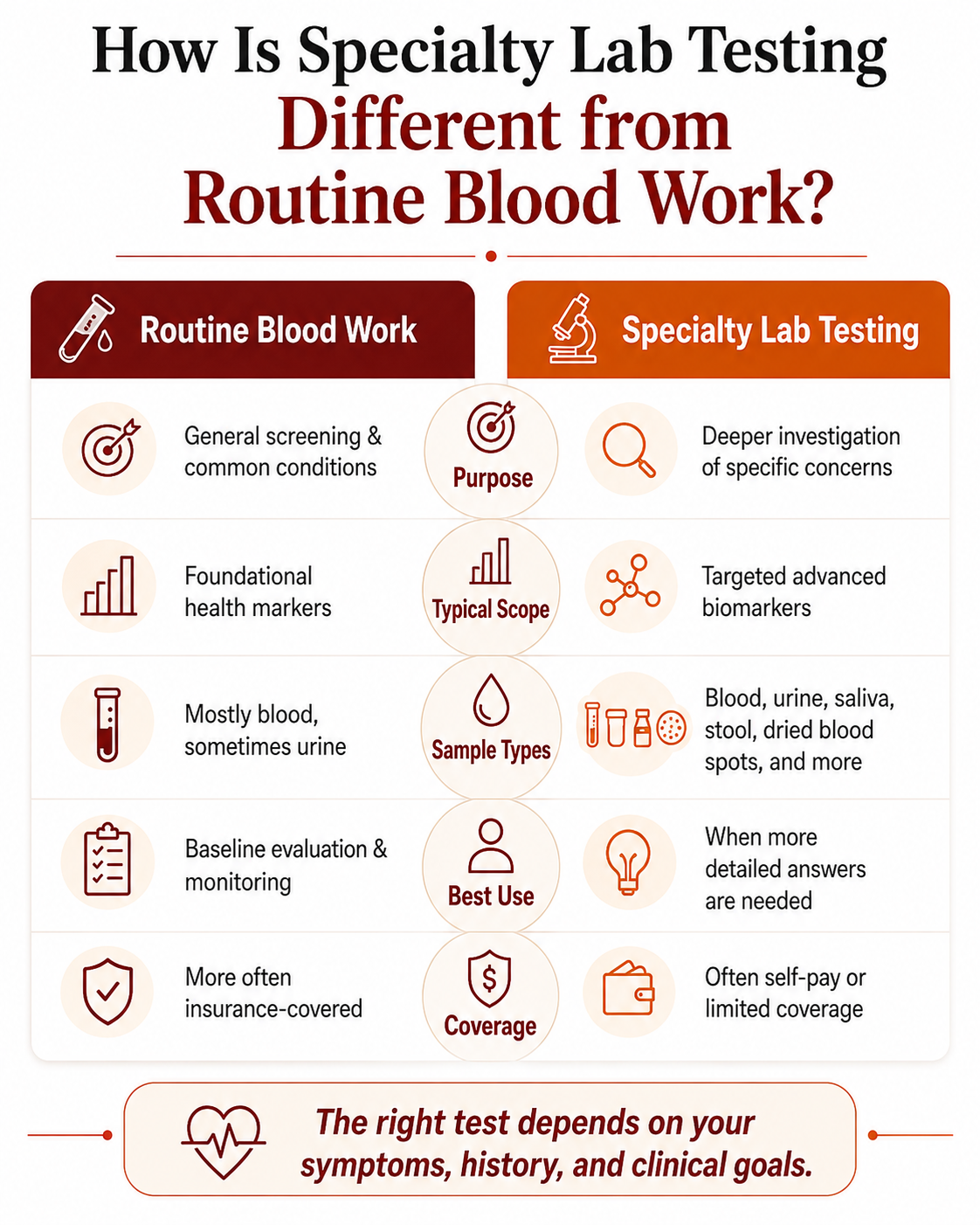
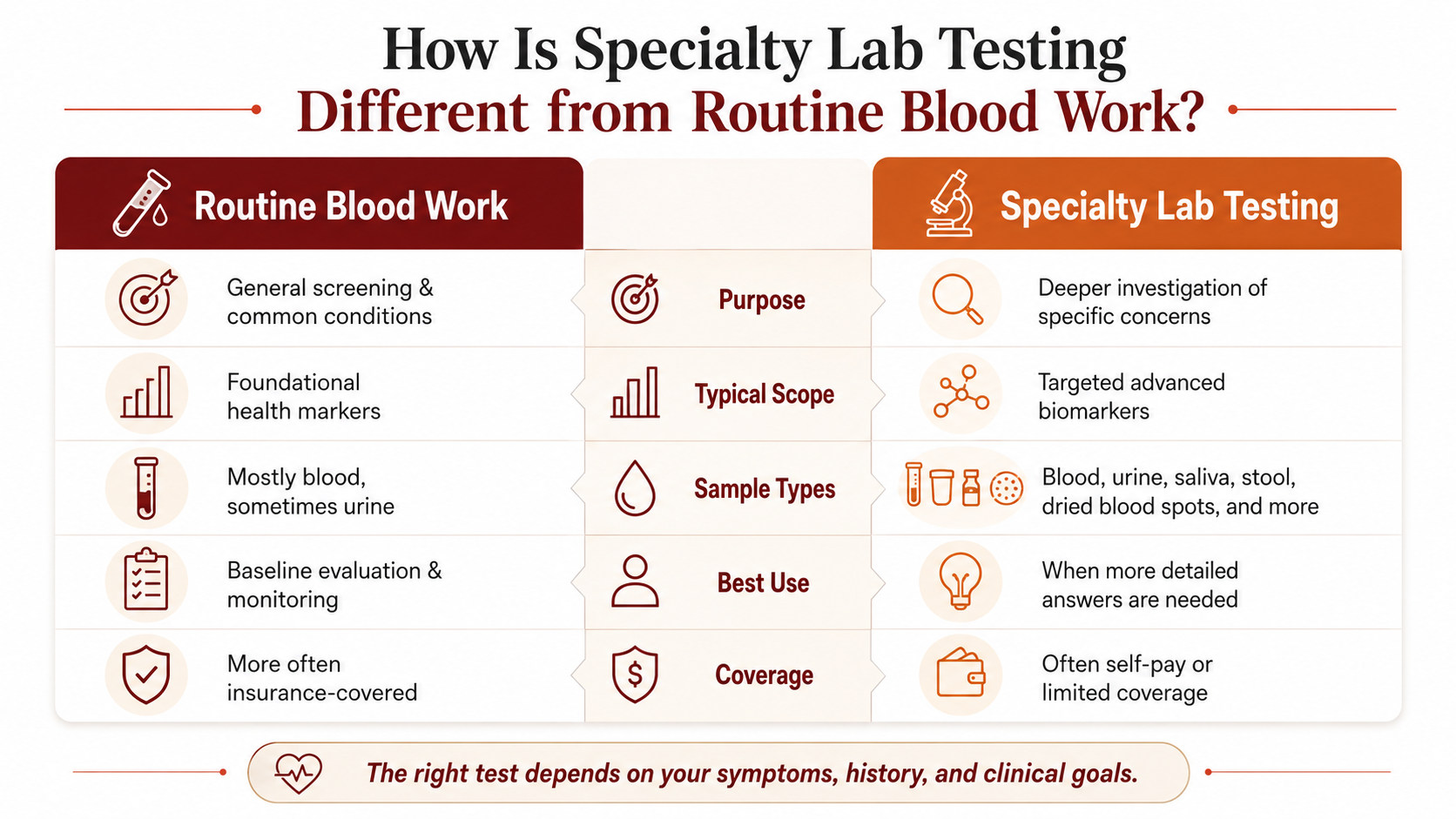
Routine blood work usually provides a broad foundation
Routine tests are commonly used to assess general health, establish a baseline, screen for common medical problems, and monitor known conditions or medications.
Specialty testing usually investigates a narrower question in greater depth
A specialty panel may examine more markers within one area, assess relationships between several findings, use a different specimen type, or evaluate a biological process not included in routine testing.
Routine testing frequently uses standardized, widely available panels
Tests such as a CBC, metabolic panel, lipid panel, glucose test, and thyroid test are available through most conventional clinical laboratories.
Specialty panels may only be offered by selected laboratories
Certain tests use proprietary methods, specialized technology, unusual specimen types, or laboratory-developed testing processes that are not available through every local laboratory.
Routine testing commonly uses blood or urine
Although other specimens may be used when clinically indicated, most general screening begins with blood and sometimes urine.
Specialty testing may use several different specimen types
Depending on what is being evaluated, specialty testing may involve blood, urine, saliva, stool, dried blood spots, cheek swabs, or multiple samples collected over a defined period.
Routine results are often available relatively quickly
Turnaround time depends on the laboratory and individual test, but commonly ordered tests are frequently processed faster than extensive specialty panels.
Specialty testing may require more processing and interpretation
Some panels examine dozens or hundreds of markers, use specialized analytical methods, or require multiple collection steps. Results may therefore take longer and require a more detailed review.
Routine tests are more commonly covered by insurance
Coverage still depends on the patient’s health plan, diagnosis, network, deductible, and medical-necessity requirements.
Specialty panels are more frequently self-pay
Some advanced tests may be covered, but others are considered elective, investigational, out of network, or not medically necessary under a particular insurance policy.
Is Specialty Testing More Comprehensive?
Specialty testing may be more detailed within a particular area, but the word “comprehensive” can be misleading.
A panel containing more biomarkers is not automatically more accurate, clinically meaningful, or useful. The value of a test depends on:
What the test is designed to measure
Whether its methodology has been appropriately validated
How sensitive and specific it is for its intended purpose
Whether reliable reference ranges are available
Whether an abnormal result has established clinical significance
Whether the result can reasonably change medical care
Whether a more established test could answer the same question
The risks of false-positive, false-negative, or incidental findings
The financial cost to the patient
Some specialty panels are laboratory-developed tests designed, manufactured, and used within a single clinical laboratory. The quality and clinical usefulness of individual tests can vary, making careful test selection particularly important.
Laboratories conducting human diagnostic testing in the United States are generally subject to Clinical Laboratory Improvement Amendments requirements. CLIA establishes quality standards intended to support accurate, reliable, and timely laboratory results. However, laboratory quality oversight does not necessarily mean that every available biomarker has proven clinical value for every symptom or condition.
The best test is therefore not necessarily the largest panel. It is the test most likely to answer the specific clinical question being investigated.
Should Routine Blood Work Usually Be Completed First?
In many situations, yes.
Symptoms such as fatigue, low energy, headaches, brain fog, weight changes, sleep disruption, digestive discomfort, or reduced exercise tolerance can have numerous possible explanations.
Foundational testing may identify common and medically important causes such as:
Anemia
Thyroid dysfunction
Diabetes
Kidney or liver abnormalities
Electrolyte disturbances
Iron deficiency
Medication effects
Infection or inflammation
Selected nutritional deficiencies
Routine blood work can sometimes identify the concern without the cost or complexity of an extensive specialty panel.
That does not mean routine testing must always come first in every situation. A patient with a specific exposure, family history, previously abnormal result, complex medical condition, or well-defined clinical concern may sometimes proceed directly to targeted testing.
The testing sequence should be based on the patient’s history and the question the physician is trying to answer—not an automatic requirement to complete the same panels in the same order for every person.
To understand why foundational testing remains valuable, read Why Do I Need Blood Work?.
When Might Specialty Testing Be Considered?
Specialty testing may be considered when:
Symptoms remain unexplained after an appropriate initial evaluation
Routine testing has not fully answered an important clinical question
A patient has a significant family history or specific risk factor
More detailed cardiovascular or metabolic assessment may affect care
A credible environmental or occupational exposure is suspected
A physician needs additional information about hormone metabolism
Persistent digestive symptoms warrant a more targeted evaluation
Selected nutritional or absorption concerns remain unresolved
A complex condition involves several potentially overlapping factors
The result could meaningfully change treatment or monitoring
Specialty testing may also be considered as part of preventive healthcare and health optimization when the test is relevant to the patient’s individual risk factors and when the findings could lead to an evidence-informed action.
Feeling unwell does not automatically mean that the largest available panel is appropriate. Sometimes the better next step is additional conventional testing, a physical examination, imaging, medication review, sleep evaluation, dietary assessment, specialist referral, or monitoring over time.
Do Normal Routine Results Mean I Need Specialty Testing?
No.
Normal routine blood work does not rule out every possible medical condition. However, it also does not automatically establish a need for advanced testing.
When routine results are normal but symptoms continue, the next step depends on:
Which symptoms are present
Their severity and duration
Which tests have already been completed
Your medications and supplements
Your personal and family history
Relevant lifestyle factors
Whether a physical examination is needed
Whether imaging or specialist evaluation may be more appropriate
Whether the proposed specialty test has meaningful clinical evidence
Whether the result would change your care
In some cases, targeted specialty testing may provide useful additional information. In others, it may add cost and complexity without improving clinical decision-making.
Can Specialty Testing Diagnose the Exact Cause of a Symptom?
Not necessarily.
An abnormal laboratory result can be relevant without proving that it is the sole cause of a symptom. A finding may:
Be directly related to the concern
Represent one of several contributing factors
Reflect a past exposure rather than an active problem
Be affected by medication, diet, exercise, illness, or collection timing
Require confirmation with another test
Represent normal biological variation
Be unrelated to the current symptoms
This is particularly important when a panel measures many biomarkers. The more markers that are measured, the greater the possibility that at least one result will fall outside its reference range even when it is not clinically significant.
Laboratory findings should be interpreted alongside the patient’s symptoms, medical history, previous results, physical findings, medications, exposures, and other appropriate testing.
Can Routine and Specialty Testing Be Used Together?
Yes. This is often the most useful approach.
Routine blood work may establish the patient’s overall medical foundation, while a carefully selected specialty test investigates one area in greater depth.
For example:
A standard lipid panel may be combined with selected advanced cardiovascular markers.
Routine thyroid testing may be combined with additional hormone testing when clinically appropriate.
A CBC, metabolic panel, and iron studies may be reviewed before considering more extensive nutritional testing.
Established gastrointestinal evaluation may be combined with selected stool testing for a clearly defined digestive concern.
Conventional exposure testing may be combined with focused specialty analysis when there is a credible environmental or occupational history.
Routine and specialty testing should not be viewed as opposing approaches. Each can provide useful information when it is selected for the right reason.
The goal is to avoid both undertesting and indiscriminate overtesting.


How Does a Physician Decide Which Testing Is Appropriate?
A physician-guided testing strategy begins before any sample is collected.
Your physician may review:
Your current symptoms and concerns
Personal and family medical history
Existing diagnoses
Medications and supplements
Previous laboratory and imaging results
Nutrition and lifestyle
Travel history
Environmental and occupational exposures
Relevant physical findings
Your health goals and priorities
The evidence and limitations of the proposed test
Whether the result is likely to change your care
Existing records should also be reviewed whenever possible. This can help prevent unnecessary duplication and identify which important questions have not yet been addressed.
Before completing specialty testing, patients should understand:
Why the test is being recommended
What the test measures
Which specimen is required
How to prepare for collection
The test’s major limitations
The anticipated turnaround time
The estimated laboratory cost
Whether insurance may provide coverage
Whether a physician consultation and interpretation are included
How the possible results could affect the treatment plan
What Happens After the Results Are Available?
Receiving a laboratory report is only one part of the testing process.
During a results-review appointment, your physician should help determine:
Which findings are most meaningful
Which findings may be incidental
Whether any results require confirmation
How the results relate to your symptoms and history
Which concerns should be prioritized
Which findings can simply be monitored
Whether additional conventional testing is needed
Whether another healthcare professional should be involved
What reasonable treatment options are available
Depending on the results, recommendations may include:
Nutrition and lifestyle changes
Targeted supplementation
Medication management
Additional laboratory testing
Imaging or other diagnostic studies
Referral to a specialist
Symptom or biomarker monitoring
Repeat testing when clinically appropriate
No immediate treatment when a finding is unlikely to be meaningful
The objective is not to treat every marker that appears outside the laboratory’s reference range. The objective is to identify which findings matter and develop a focused, practical, and medically appropriate plan.
Frequently Asked Questions
-
Not necessarily. Specialty testing may provide more detail about a selected concern, while routine testing provides a valuable foundation for evaluating general health and common medical conditions.
The appropriate choice depends on the clinical question—not which panel contains the most markers.
-
Usually not. Routine testing and evidence-based preventive screening remain important even when a patient completes specialty testing.
A specialty panel may not include basic assessments of blood-cell counts, kidney function, liver function, blood sugar, cholesterol, or other foundational measurements.
-
No. Specialty tests may use blood, dried blood spots, urine, saliva, stool, cheek swabs, or another specimen type. The appropriate sample depends on what is being measured.
-
No. An abnormal result may represent a clinically important concern, temporary change, previous exposure, medication effect, collection issue, biological variation, or incidental finding.
Some results require confirmation before a diagnosis or treatment decision can be made.
-
Coverage varies by insurance plan, laboratory, diagnosis, network, and test. Some advanced tests may be covered when they meet medical-necessity requirements, while others are self-pay.
Patients should confirm expected costs before submitting a sample.
-
Direct-access testing is available for some panels, but ordering a test without first defining the clinical question may lead to unnecessary expense, confusing findings, or inappropriate conclusions.
A physician can help determine whether the test is suitable, review possible alternatives, identify preparation requirements, and interpret the results within the context of your overall health.
Learn More About Specialty Laboratory Testing
Routine blood work and specialty laboratory testing serve different but potentially complementary purposes.
Routine testing provides a broad medical foundation. Specialty testing may investigate a selected area in greater depth when there is a clear clinical reason to do so.
Neither approach should be based solely on the number of biomarkers included in a panel. The most useful testing strategy is the one that is personalized to your symptoms, medical history, previous results, risk factors, exposures, and health goals.
For a more extensive overview, read Specialty Laboratory Testing: A Complete Guide for Patients, A Patient’s Guide to Specialty Laboratory Testing, or What Is Specialty Laboratory Testing?.
To discuss whether routine or specialty testing may be appropriate for you, explore our Specialty Laboratory Testing services or contact Ask Dr. Hu to request a consultation.
The information in this article is provided for general educational purposes and does not replace individualized medical advice, diagnosis, or treatment. Laboratory recommendations should be based on your symptoms, medical history, examination findings, previous results, and the professional judgment of a qualified healthcare provider.